
Chapter Text
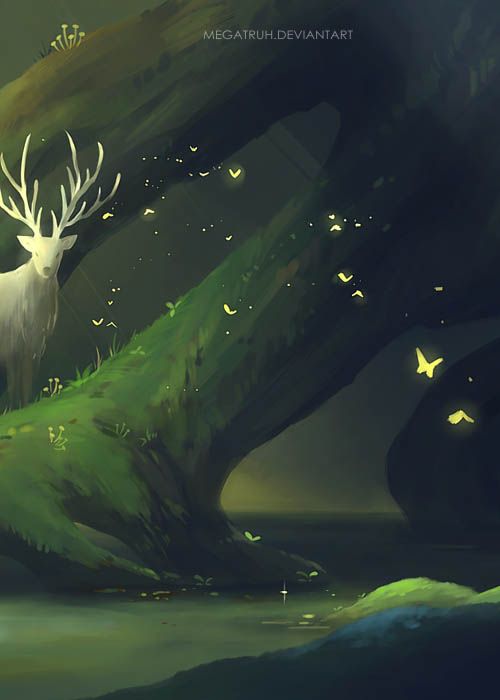
The White Stag of Mirkwood by megatruh.
When Thorin turned twenty-two, his grandfather King Thror entrusted him with important business, even though Thorin would not fully come of age for nearly a decade. The task: to choose the year's trees.
Coal from the Iron Hills kept Erebor's smelting furnaces aglow, but for the royal forges, in which the last of the Moria true-silver was fashioned into wonderful objects by Thror himself, the clean flame of hardwood charcoal was preferred.
But no large stands of mature trees, the raw material for charcoal, remained near the Lonely Mountain. To obtain the wood, the dwarves of Erebor made an annual journey by boat to the Little Greenwood, a small woodland divided by the River Running from the vast, dark – some said accursed – forest of Mirkwood.
I'll send you to Mirkwood had long been a potent threat to frighten dwarf children into good behaviour. Mirkwood was rumoured to have vampire bats, gigantic spiders, and other creatures horrible beyond reckoning. Thorin suspected the rumours were fairy tales, but there was one danger Mirkwood undeniably had: elves.
Elves were immortal, hazardously silly, and not fond of dwarves. Unfortunately, the elves could not be avoided, as the Little Greenwood did not belong to Thror, but to the Elvenking, Thranduil, who ruled over all of northern Mirkwood.
Some years before Thorin was born, Thranduil had granted logging rights to Thror in return for Ereborian gold, but Thranduil could withdraw the rights if he was displeased – and it was practically inevitable the Elvenking would be displeased, according to Thorin's cousins Gloin and Oin, who had had tree detail the previous year. Thorin had not heard the full tale, but it was all too easy to imagine the trouble his elder cousins had landed in, since they had failed to meet the full tree quota, and Thranduil had forbidden the two dwarves from ever returning to the elven woodland realm.
Still, between Mirkwood and Erebor there had long been peace, and, more importantly, profitable trade. Thorin would have to take care not to antagonize the elves, for charcoal was vital to Thror's forges, which burned night and day. Indeed, night and day had little meaning in Erebor, for the dwarven city always blazed with light. On the rare occasions Thorin beheld the naked evening sky, he found the stars feeble and cold compared to Erebor's golden lamps.
With the blessings of his father and grandfather, Thorin set out for Mirkwood on Midsummer Eve.
Thorin's departure was not universally joyful. Frerin and Dis, his younger brother and sister, cried and begged to go with him, but they were still children in the care of nurses. To stop their tears, he promised to bring them magnificent gifts from his travels. There would be nothing in the woods to rival dwarven-made toys, so Thorin regretted his promise almost as soon as he made it.
The first leg of the journey was a leisurely pony ride from Erebor along the River Running (here too steep and swift for comfortable water travel) to the Long Lake, where Thorin and his company boarded a boat.
Thorin was not traveling alone. Far from it. Three companions – two bodyguards, and an elderly servant from the royal household – had been chosen by Thror. Allowed to choose one for himself, Thorin had selected his cousin Dwalin. In addition, the hired boat was crewed by three Lake-men.
The two bodyguards, Nari and Nali, were satisfyingly respectful, but the servant, Blain, had known Thorin since infancy and was inclined to nanny him. Nevertheless, Thorin regarded the boat (admittedly a humble barge) as if it were his kingdom, and all aboard his subjects. It was the first time he had been given complete responsibility over others while away from home.
The crowd of attendants irked Thorin slightly, even though he understood why his grandfather was worried about his safety in the wilderness. But Thorin was sure he was equal to the task ahead, even if he had set out alone, because he had learned everything befitting a prince.
Thorin was already skilled in the mining and working of precious metals, but all dwarves, girl or boy, were practically born with that knowledge. It was his other accomplishments Thorin took pride in. Nearly five feet in height, he could expertly ride a pony, and once (on a dare from Dwalin) a horse. Even by the high standards of his people, he was superb with the bow, the axe, and the sword, because it was a prince's duty to defend his folk from every danger.
Not that there was any danger to speak of in Erebor. Fast inside the Lonely Mountain, the dwarven city needed little protection. Its outer walls were fashioned from an impenetrable green stone forged long ago in a convulsion of the earth. Erebor was so strong, and the surrounding lands so peaceful, Thorin sometimes regretted being born into a time of quiet, for there were no opportunities for adventure. In the Little Greenwood, Thorin did not expect to meet with anything truly dangerous – but it was pleasant to imagine he might.
It was Thorin's turn as lookout. His bow at the ready, he stood at the front of the boat and gazed ahead.
It was their third day out from Erebor. Trees pressed close on either bank of the River Running. On the west was Mirkwood; on the east the Little Greenwood. A faint tow path ran along the eastern bank.
At sunrise that morning, they had passed from the Long Lake into the mouth of the River Running, which resumed its solitary course to an inland sea hundreds of miles away to the southeast. Their river journey would be only the length of the Little Greenwood, fifty miles. They traveled with the current, and the Lake-men were at their oars, so progress was brisk.
Thorin was not watching for the rumoured monsters of Mirkwood, or even an outlaw (rare was the bandit foolish enough to attack a well-armed party of dwarves), only for their landing place, but he deemed it wise to keep his bow drawn anyway.
Thorin had accompanied Gloin and Oin when they had been dropped off the year before, so he was confident he would recognise the landing place. It was said to be near the Old Forest Road – the Men-i-Naugrim, as the elves called it. No dwarf gave it that name, for naugrim, the Elvish word for dwarves, translated to the insulting term stunted.
The ancient dwarven-built road had traversed Mirkwood, linking the eastern lands to the mountain pass to Eriador in the west, and to the Great River which flowed south to the sea, but most of all to Khazad-dum, once the largest and richest of the old dwarven kingdoms, called Moria by elves and men. Centuries earlier, there had been great traffic on the Old Forest Road; now there was none, for Moria had fallen to evil long ago. No dwarf now living had laid eyes on the road, much less used it to cross the wilderness of Mirkwood.
The river widened, turning rocky and shallow. The Lake-men navigated with care, until they at last reached the landing place at sunset. Back on good, solid earth, Dwalin lit a fire. While Blain cooked their supper, Nari and Nali put up a tent for Thorin and Dwalin; the rest of the party would sleep in the open air.
The Lake-men had come ashore with them, to pass the night before leaving for their homes in the morning. Thorin and his companions would slowly retrace the river route on foot, selecting trees for felling as they went, until they drew near the Long Lake. There the Lake-men would pick them up a month hence.
The Little Greenwood was frightfully tree-ish to Thorin, but its open woodland was nothing compared to Mirkwood proper, which could be seen across the river from their camp. The legendary forest's trees rose as sharp and solid as a cliff-face, casting a darkness which seemed unnatural to Thorin, who was unaccustomed to gloom unconquered by lamps. The dismal sight was at least softened by the full moon's slender beams glimmering on the wide river.
After supper, Thorin brought out his small traveling harp. Dwalin had his fiddle, and the Lake-men contributed reed pipes and a drum, so it was a merry evening of music and song.
When he retired to the tent with Dwalin, Thorin was nearly as comfortable as he was in his bedchamber of carven stone in Erebor. Outside, water rushed with a pleasant sound over smooth stones. But it did not lull him to sleep immediately; instead he turned over the evening in his mind.
While Thorin had played his harp, a patch of light had appeared in the trees across the river. Moonlight reflected in the water, perhaps, but the light seemed to move independently, first appearing upriver, then down.
Tales told of people seeing illusions in Mirkwood, terrible things that brought them to the brink of madness, so Thorin had resolutely looked away. Whatever it was that he had seen he put down to a momentary fancy.
The next morning, before the Lake-men and their boat were out of sight, Thorin and his companions packed up. Thorin was eager to start because the trade agreement gave him only a month, scarce time to accomplish his task, though thankfully Thorin was responsible only for selecting the trees, not felling them. That chore the elves reserved for themselves.
They found a path and entered the woods. The ground was level, the forest floor free of boulders or streams, but this section of the Little Greenwood was too picked over for any of its trees to be harvested. They would have to travel further north each day, and deeper into the wood.
Thorin could say with precision when events turned against them.
Blain was cooking their evening meal on the second day when three owls swooped upon their fire.
The owls' wings hurled ashes into the dwarves' faces, temporarily blinding them. In the confusion, the owls snatched the sausages cooking on the fire. Nari and Nali waved their arms and shouted, but the owls were already in the treetops with the stolen dinner.
Blain put the fire in order and cooked more sausages. Dwalin stood guard, wielding an axe.
Thorin was not troubled, at first. They were well supplied, and, if their food ran low, they were permitted to hunt – with elven restrictions, naturally.
The animals they were forbidden to kill (a long list including owls, eagles, stoats, hedgehogs, and snakes) were all animals dwarves considered inedible, except for one: white deer, which were reserved for the Elvenking's hunting parties.
It was said that anyone who harmed a white deer in Mirkwood was never seen again, and many were the goblins (and even a few men) who had failed to heed the warning, and had subsequently disappeared. According to the tales, the transgressors were killed by Mirkwood's magical guardian, a great white stag.
Thorin had never seen white deer; he doubted they existed. The story about the white stag, like so many about Mirkwood, was ridiculous.
But the night after the depredations of the owls, badgers took the dwarves' bread. The night after that, foxes stole the remaining sausage, and most of the cheese. Thorin at last grew worried, but above all angry. Animal bandits seemed the sort of mischief elves were likely to be at the bottom of.
Dwindling food was not their only problem. Thorin had found and marked only three trees in the four days since they had arrived. Finding trees that met the Elvenking's restrictions was no easy task, for each selection Thorin made affected his future choices; there were quotas for each tree species, as well as for size. At his current rate, his mission would take him nearly half a year, not the month allotted.
For the second time since beginning the day's tree hunt, Thorin consulted his map. Dwarven surveyors had divided the Little Greenwood into a grid, with stone markers at regular intervals. The map showed where trees had been taken in the past.
Getting the necessary wood had not always been so onerous. Once the elves had performed every step: selected the trees, felled them, and delivered the logs to Erebor. But when Thorin was a young lad of seven, Thror had accused the elves of providing wood of declining quality, and had insisted the dwarves do the logging themselves. After much wrangling, Thror and Thranduil reached a compromise: the dwarves would select the trees, but the elves would fell them, and delivery was turned over to the Men of the Lake.
After two hours of searching, Thorin at last found another suitable tree. He took a metal stake out of a bag on his belt and prepared to hammer the stake into the tree at eye-level. The stake markers were provided by the elves; only sixty markers had been allotted this year.
Just when Thorin was about to hammer the stake with the wide blunt edge of his axe, Dwalin called out, "Thorin, wait!"
Dwalin pointed up. An owl was perched high in the tree, its round head sticking disapprovingly out of a hollow.
Trees home to birds of prey were not allowed. If Thorin had marked the tree, the elves would not have felled it, but returned the marker to Thror with a chilly note about the rules. Gloin and Oin had failed to meet the quota the previous year because so many of their choices had been rejected by the elves.
Thorin took out his copy of the logging contract, which began At King Thranduil's pleasure, the only clear phrase it seemed to contain. As he read the elaborate script, looking for a possible exception, Thorin seriously considered he might fail, as Gloin and Oin had. Perhaps he should give up, return to Erebor, and let someone else take on the task.
But once the month elapsed, the dwarves would not get another chance to obtain wood until the following year. It could take two weeks to return to Erebor, and for a new party to reach the Little Greenwood. Thror had already paid a flat rate for the trees. If Thorin did not meet the quota within the allowed thirty days, his grandfather would suffer a loss. Thorin had to persevere no matter how small his chance of success.
After they returned to the river to make camp in the late afternoon, Thorin announced they would have to hunt that evening to eke out their stores; too much food had been lost. Hunting meant longer days, but Thorin did not point that out. His companions' glum faces announced they knew full well.
Nari and Nali went south, while Thorin and Dwalin went north. Blain remained at the camp to guard their remaining food.
Thorin had gone hunting many times with Dwalin, so they maintained a comfortable silence as they made their way along the riverbank, but Thorin felt an unusual excitement. It was the first time in his life a hunt truly mattered.
As the day's light waned, animals would come to the river to drink. When Thorin and Dwalin reached a likely spot, they sat in a clump of tall grass, but saw only small creatures such as squirrels, and once perhaps a weasel. It was difficult to tell in the fading light.
Suddenly a red deer appeared not twenty feet away, sprinting for the river. Without pausing for thought, Thorin let fly an arrow. When the arrow landed in the deer's flank, Dwalin cheered.
The deer slowed, but it did not halt, and was soon across the river, where it vanished into the trees on the opposite bank.
For a moment, they were still and silent with disappointment, then Dwalin waded purposefully into the waist-deep river.
"Dwalin, come back!" Thorin said.
They were forbidden to take game on the west side of the river – in Mirkwood proper – and although Thorin had shot the deer on the east bank, crossing the river to retrieve game was undoubtedly the sort of thing that earned the Elvenking's displeasure.
"It will take only a moment," Dwalin said. "As long as you stay where you are, Thorin, no fingers can be pointed at you, and that is all that matters."
Thorin hesitated over his decision. He was regretting the shot more with each passing moment.
The deer was without antlers in midsummer, so it was a doe, and doe hunting season did not begin for another two months. Not to mention he had not killed the doe outright. It was unpleasant to imagine the wounded doe dying a slow death. Dwalin could at least end the beast's suffering. And besides, Thorin knew Dwalin was eager to prove himself as Thorin's indispensable companion.
"Go, then, as quickly as you can," Thorin said, nodding assent.
Nari and Nali appeared at a run; they had evidently heard Thorin and Dwalin calling to one another.
"Follow Dwalin," Thorin ordered. "Help him retrieve a deer I shot."
Dwalin had reached the opposite bank. Nari and Nali quickly crossed the river, and disappeared with Dwalin into the trees.
A few minutes later, when Blain also appeared, Thorin explained what had happened. Blain made a disapproving face, and paced fretfully up and down the riverbank. Thorin would have found it annoying, but as time passed he grew increasingly fretful himself. If the deer could be found, Dwalin would have found it by now. After a quarter of an hour, Thorin could wait no longer.
"Stay here," Thorin told Blain.
Ignoring Blain's protests, Thorin forded the shallow river. Trees and underbrush crowded the west bank. Roots reached greedily into the water. Thorin had to force his way into Mirkwood through grasping branches. The sun had set, and only a faint light filtered through the towering trees. After a few minutes of tiring struggle, he reached a small clearing barely large enough to lie in.
"Thorin!" Dwalin whispered, then Thorin could see Dwalin crouched down on the ground; Nari and Nali stood close by.
Relieved, Thorin knelt at Dwalin's side. "We must return to the river before we lose the light," Thorin said. "Come! Forget about the deer."
Dwalin held up an object, the broken end of Thorin's arrow. Thorin could barely make it out.
"The deer is nearby," Dwalin whispered. "I saw it."
Thorin knelt beside Dwalin and peered into the forest. He could see only dark, looming shapes, which his mind told him were trees, but his heart told him were something more sinister. He was about to question Dwalin's sighting of the deer in the gloom when leaves rustled behind them.
Dwalin turned to look, and his eyes were suddenly round and staring.
"The guardian of the forest!" Dwalin cried.
Nonsense, that is a horse, was Thorin's first thought when he turned around.
It was not a horse. It was an enormous white stag, the tips of its antlers eight feet above the ground. A faint radiance came from its white hide, dazzling Thorin's eyes.
The stag lowered its head, as if it intended to spear them on its great antlers. Thorin and Dwalin sprang to their feet. Nari and Nali exclaimed in fear.
"Steady now," Thorin said. "We are safe enough, I deem. This clearing is too small for the stag to enter."
As if to mock Thorin's assurance, the white stag reared up. Its hooves came down hard on a fallen tree, shattering the log.
The dwarves turned and ran as fast as they could through the dense vegetation. When Thorin reached the riverbank, he waited. Nari and Nali emerged from the trees. Dwalin did not.
Cursing, Thorin had turned to go back into the forest, when Nali called out, pointing down the riverbank to where a dark form lay. Thorin hastened to it, and was vastly relieved to find the shape was Dwalin, and that Dwalin was unharmed by deadly hooves. But something was wrong. Dwalin appeared to be asleep, of all things, and lay peacefully beside a dark stream emptying into the river. His eyes were closed, and there was a foolish smile on his face.
Thorin knelt and placed his ear against Dwalin's chest; Dwalin's heart beat strongly. Less frightened, and therefore more annoyed, Thorin shook Dwalin vigorously.
"Awake!" Thorin demanded.
Dwalin slumbered on.
"Do not touch the stream, Master Thorin!" Blain called from across the river.
Nari and Nali carried Dwalin back across the river to their camp, and placed him in the tent. Thorin helped Blain remove Dwalin's sodden boots, then Blain covered Dwalin with a blanket.
"Dwalin must have stepped in an accursed stream," Blain said with ponderous solemnity. "He is under an enchantment of Mirkwood. A bewitched sleep."
"Ridiculous," Thorin said, but the sight of the white stag had rattled him, and his voice wavered.
"Mirkwood's enchanted streams can make a man sleep for weeks," Blain said. "I heard of a man who slept for half a year. It is said a sorcerer has taken over Mirkwood, and cursed it with a dark spell."
This was preposterous, but Nari and Nali nodded in agreement. Thorin did not argue the point; there was nothing to do but eat a frugal supper, go to bed, and see if Dwalin woke in the morning.
Dwalin did not wake the next morning, or the next, so Thorin announced that Dwalin must be taken back to Erebor and put in the care of Oin, who would know how to break the inconvenient enchantment. Dwalin would be hugely disappointed to have been sent home, but that could not be helped.
Nari and Nali would have to carry Dwalin upriver to the Long Lake, where they could wave down a passing barge or fishing boat. The two guards agreed to this without complaint, although it would be a weary journey. But when Thorin told Blain to go as well, leaving Thorin alone to carry out the tree mission, Blain protested.
Thorin was ready for it. He pointed out that Nari and Nali, burdened with carrying Dwalin, would have an easier journey if Blain looked after them along the way.
While Nari and Nali built a makeshift litter for Dwalin, Thorin took Blain aside and said in a quieter tone, "I need you to take a message to King Thror. Tell him the elves may be sabotaging my mission, and to send me six hearty dwarves, well-supplied, or I may fail to complete the task he has set me."
Blain looked unconvinced.
"I cannot trust such a message to Nari and Nali," Thorin added. Entirely untrue, but it had the desired effect.
"Of course, Master Thorin," Blain said, chest swelling with importance.
Thorin nearly added, "Tell Thror owls stole our sausage," but the phrase was so ludicrous he merely said he would camp on the riverbank each night so the relief party could easily find him.
They divided up the supplies. Thorin kept the fishing equipment, and took nearly all of the arrows, giving the departing dwarves most of the remaining food, as well as the tent to protect the helpless Dwalin at night.
Thorin assisted Nari and Nali in finishing Dwalin's litter, then watched his companions depart northward, leaving him alone. If Nari and Nali made good time, and found lake transport swiftly, it could be as little as ten days before the relief party from Erebor reached Thorin. During that time, Thorin planned to find and mark as many trees as he could. He still had forty-six to go.
Despite the setbacks, Thorin was exhilarated. He was free to choose when he slept, when he woke, and where he went. Free of the constant chatter of Blain. It was the first time Thorin had been truly on his own, and he relished it.
Thorin found and marked four trees that day, justifying his high spirits, and was going to continue searching when he recalled he had to set up camp alone. He returned to the river, collected firewood, and got a blaze going, even though it was still an hour before sunset.
After eating a light meal of cram (hard bread rolls made by Lake-men) and dried meat, Thorin took the precaution of suspending his food pack from a tree branch twenty feet up. No foxes or other scavengers would get a single crumb more from him!
Wrapped in his cloak and a blanket, Thorin found it pleasant to lie by the fire as the sun went down and the sky turned from pale red to deep blue.
The sun sank completely, leaving Thorin in the fire's small circle of light. All else was blackness. It was as if the world had shrunken and disappeared.
Thorin looked up; the stars would put an end to the illusion of nothingness. A huge moth flew in his face. Thorin waved it away. Another moth collided with his hand.
Within moments hundreds of moths were all around him, attracted to the fire. He tried to brush them off, but there were too many. Pulling his blanket over his head brought momentary relief, but the night was stifling, and the blanket felt smothering. Thorin missed the tent more than he had expected.
Thorin reluctantly put out the fire. When the moths left in disappointment, he lay back down. With the fire out, he could at last see the stars in the night sky. He had never slept under the open sky before; always there had been a barrier between him and the heavens. Even on the boat, he had slept under an awning to keep out the damp night air.
The stars above Mirkwood seemed brighter than everyday stars, and moved with a strange swiftness on their appointed paths, like silver fish in a black swirling pool. Thorin felt as if he would slip off the face of the earth and fall into them and be drowned.
To steady himself, he imagined the stars as lamps within Erebor. When that failed as a distraction, he pulled his blanket over his face again, but it was still too hot. From the stars there was no escape.
Thorin woke in the grey light of dawn. His first thought was gratitude for finally sleeping after hours of uneasy wakefulness.
The thought fled when there came a loud crashing noise close by, like a giant striking a tree with a massive hammer. Thorin sat up, his mind clearing. A similar crash must have awakened him.
He was heartily inclined to ignore the noise; it suggested a large wild animal. Then Thorin realised the sound originated from the tree suspending his food pack.
Thorin threw off his blanket and cloak. He had slept with his boots on, as anyone of sense did when alone in the wilderness. He seized his axe, which was near at hand.
Another tremendous crash. It had to be a bear.
Thorin strapped on his bow and quiver, and checked his belt for his knife. How the weapons would serve him against a massive wild animal he did not know. It took all the courage he possessed to go in search of the beast trying to take his food.
What he found was more alarming than a bear. It was the white stag.
Just as Thorin arrived at the tree, the stag charged it and hit the trunk with its antlers, making the crash Thorin had heard. The tree shook violently, and the pack slid down a few inches.
Thorin's fear turned to anger. "You!" Thorin said.
The Elvenking's rules said nothing about forest animals staying on the Mirkwood side of the river, but Thorin considered the stag's presence in the Little Greenwood to be unfair. Thorin knew his anger was illogical – what would a stag care for anyone's edicts, real or not? – but he was angry nonetheless.
"Shoo!" Thorin shouted. "Go home!"
He spoke to the stag in the common tongue, not because he thought the stag would understand it, but because Dwarvish was spoken only to other dwarves.
In the rapidly growing morning light, Thorin could see the stag more clearly; he had had only a brief panicky glimpse in near darkness the first time. About the stag's neck was a thick ruff of fur, a majestic neckmane a dwarf lord would have been proud of.
After staring at Thorin for a moment, the stag took a step toward him. Thorin braced himself, expecting the stag to charge, but instead the stag made a teasing skip, as if Thorin was a fawn the stag was inviting to play.
Thorin did not know why the stag had dropped its belligerent demeanor. Because Thorin was alone and less of a threat?
Thorin fitted an arrow to his bow. He sensed an ill fate would befall him if he was to fire upon the stag, but he had to have his food pack. Without it, his mission was doomed to failure. All his time would be taken up with hunting.
Ignoring him, the stag charged the tree once again. Its antlers collided with the tree trunk with a horrific crash. Bark flew, the tree shuddered, and the food pack came tumbling down.
Before Thorin could react, the stag lowered its head and scooped up the pack, the pack's rope wrapping obligingly around an antler. The stag turned tail and ran toward the river. It leapt across the water from stone to stone, foam flying from its hooves, the morning sun shining on its white hide.
Thorin followed, jumping from stone to stone in imitation of the stag, and made it across the river without getting more than one leg wet. For the second time he entered Mirkwood, following in desperation and in anger, picking up items dropped from the stolen food pack as he went.
The recklessness of what he was doing soon chilled him. In a short time, no more than half an hour, Thorin was no longer sure in which direction the river lay, and could not reliably estimate how far he had traveled. The sun was rising, but in Mirkwood the darkness was almost absolute.
Before him was an impassable tangle of thorny vines. He would have to go around it, or turn back. Then he heard a noise ahead which he could not immediately identify, a sound of energetic but hopeless thrashing. Thorin warily circled the bramble, treading on wet decayed wood and other unpleasant things, until he saw a patch of light in the gloom.
It was the white stag, caught fast, its antlers entangled in the thorny thicket. Even in the darkness under the trees, Thorin could see the stag easily; again the stag had a faint radiance, as it had when Thorin had first seen it.
Many of the thorn bush's vines were thicker than Thorin's waist, but it was narrower shoots that had caught the stag's antlers. The stag had worsened its predicament by struggling, and was hopelessly snarled, its antlers caught as thoroughly as if the thorny shoots had been intentionally woven through them.
Disappointingly, Thorin's food pack was nowhere to be seen.
The stag stopped struggling. Its nostrils flared, smelling him. When it bellowed, the unexpectedly harsh, unlovely sound drew a tense laugh from Thorin.
"Your voice does not suit you, stag. It should be–" Thorin paused; it was foolish to speak to an animal. "It should be fair," Thorin concluded.
The stag tried to rear up, and failed.
Thorin did not think it necessary (or safe) to approach. Stags shed their antlers every year, so eventually the stag would work free, leaving its antlers behind.
But didn't deer shed their antlers in late winter? Midsummer had just passed. Perhaps the stag would not break free, but remain trapped, prey to any larger beast that came along.
Thorin pulled his axe from his belt.
Seeing this, the stag tried to rear and strike at Thorin with its hooves.
"Stop your foolishness!" Thorin said. "I shall free you, not harm you. Which is more than you deserve."
Moving slowly, and trying not to flinch each time the stag snorted forcefully, Thorin made his way into the thorny thicket.
Thorin cut away numerous vines before reaching those holding the stag prisoner. He climbed up into the thicket, perched precariously ten or so feet above the ground, until he was beside the stag. His hands and face were soon scratched and bleeding, and he felt an utter fool. Why not kill the stag and bring its fine head back to Erebor for all to marvel at? Why perform this small act of mercy, which no one would ever hear of – and would not be impressed by if they did?
In spite of the discomfort, he began to find a pleasurable challenge in the work. He followed each twisted vine to its source, then cut through it with his axe using a short chopping motion, careful not to wound the stag. Cutting the shoots which held the stag fast, without cutting the shoots which held Thorin up, required his concentration.
When Thorin had cut most of the vines, the stag attempted to rear again, as if it knew it was close to freedom.
"Keep that up and I shall fall on you," Thorin said.
The stag stilled, silent except for an occasional loud snort.
"One more vine to go," Thorin said a few minutes later.
He cut through it with his axe. The stag bucked, breaking free. Thorin collapsed in a tangle of vines. The stag leapt over him, soaring impossibly high. Cursing without restraint, Thorin crept out of the vines. He thought the stag would bolt, but it did not; it shook itself, settling its fur into perfect order.
Thorin got to his feet, brushed the dirt from his clothing, and tried to adopt a bearing as proud as the stag's.
Whether or not he believed in fairy tales, he seemed to have landed in one. If the stag was a magical beast of some sort, Thorin had to be polite, and he had to act as if he was not afraid of it.
"It's clear you are no ordinary stag," Thorin said in his best flattering tone. "Perhaps we can strike a bargain."
The stag regarded Thorin with large, dark blue eyes, and suddenly looked alarmingly intelligent.
"I apologise for crossing the river into Mirkwood earlier," Thorin said. "And I am sorry for shooting the deer, and... er, wounding it. I hope it fully recovers. But seeing as how I have set you free from what may have been a fatal trap – I refer to the thorny thicket which held you captive – and seeing as how you led me into these woods by – no doubt mistakenly – taking the only food I possess, perhaps you would be so good as to lead me back to the river. I swear never to set foot in your forest again."
The stag's eyes seemed to hold understanding, but then it only bent its graceful neck and nibbled on a moss-covered rock.
Thorin would have to offer additional incentives. Fortunately, he was prepared to. In the unlikely event he landed among ruffians, he had a gold belt to serve as ransom. He removed the gold belt from around his waist (he still had a sturdy leather belt for his axe and other necessities), and held it up so the stag could see it.
"Perhaps this will convince you to lend me your assistance?" Thorin said.
The gold belt, at first glance solid and plain, was constructed of interlocking rings in the style of chainmail, but far finer, a gossamer mesh which expanded and contracted to fit the wearer.
The stag stopped eating moss, and looked at the belt. Somehow – Thorin could not say precisely how – it looked extremely interested.
His heart beating fast, Thorin held the belt up higher. The stag ran toward him; Thorin involuntarily closed his eyes. When he opened them, the stag stood before him, its head bowed. Holding his breath, Thorin fastened the belt around the stag's neck. He was elated. The stag had accepted payment.
The stag tossed its head. The gold belt settled snugly just above its neckmane.
Then, without another glance at Thorin, the stag galloped away, and was quickly invisible in the darkness of Mirkwood.
"Come back!" Thorin yelled, equally shocked and enraged. "Come back, you ungrateful beast!"
He would have to make his way to the river without his food pack. Trying not to panic, he took stock of the supplies he had salvaged while following the stag. He had a half-empty waterskin, two pieces of cram, and a salt box. He had also thankfully brought his axe, his bow, a quiver of arrows, and a hunting knife. He had a tinderbox.
But he did not have a blanket, cloak, hood, or gloves. If he did not reach his riverside camp before nightfall, he would pass an unpleasantly chilly night in Mirkwood. No sun penetrated under the gloomy trees, and the air was far colder than it had been along the sunny river.
Thorin faced the direction he was reasonably certain he had come from, trying to retrace his steps. Before long, he spotted what seemed to be a path, and his mood lightened, until the path came to a halt at the foot of a great tree. By the time he made his way around the obstacle, he was no longer sure he was still heading in what he had guessed was the proper direction.
The sun had to be high in the sky by now; Thorin reckoned it was near noon. But from above came only a murky greenish glow, all the sunlight that could penetrate the dismally thick tree canopy.
His heart lightened once again when he found a stream. Remembering Dwalin's fate, he did not drink from it, but followed its course; it would presumably flow into the river. But after Thorin followed the stream for hours, it dropped over a small waterfall and disappeared underground, leaving Thorin as lost as ever.
It had been dark, but it was growing darker. Thorin resigned himself to spending a night in Mirkwood. Exhausted, he sat on a rock, took a few sips of water, and ate a piece of cram.
He had been warm enough while moving about, but now a chill settled on him. Should he light a fire? He could use the warmth, but in Mirkwood a fire could attract far worse than moths. He would have to do without. He began to assemble a bed of dry leaves.
The first fallen branch he picked up swarmed with glittering, whirring insects. He hurled the branch away, and shuddered.
He lay on the same rock he had been sitting on earlier, and curled up as much as possible to stay warm. As he uneasily fell asleep, his eyes shut against the darkness, he cursed Mirkwood, and most of all cursed the faithless white stag.