
Chapter Text
I’ll call you, and we'll light a fire, and drink some wine, and recognise each other in the place that is ours. Don't wait. Don't tell the story later. Life is so short. This stretch of sea and sand, this walk on the shore, before the tide covers everything we have done.
—Jeanette Winterson, Lighthousekeeping
1.
Even aboard a ship cutting its cold and lonely way up towards the Arctic, there were far more appealing exercises to be had than mathematics.
But Sir John is adamant that no time be spent idle, and that at every possible opportunity Terror’s men remain dedicated to the betterment of both body and mind, and this is how John Irving finds himself in the great cabin teaching basic arithmetic and geometry to a scattered handful of seamen and midshipmen twice a week in the evenings as part of the little school they have set up for the men.
The entire enterprise is designed more to keep the men occupied rather than truly educated, John knows. And so too do the men, judging by the bored expressions that stare blankly back at John. He doesn’t expect many to stay in his classes, and certainly not as they near the winter months— time spent on deck gazing out at the endless landscape of water and ice no doubt held more appeal for some than mathematics sums upon a chalkboard, even in a heated cabin.
Which explains John’s surprise when the Sergeant of the Royal Marines turns up one day for a geometry class.
Of all the souls here, Solomon Tozer is the last he had expected to see take part in the lessons— in mathematics least of all. Perhaps the Sergeant had a moment to spare, or perhaps he was merely seeking out the warmth of the great cabin. Whatever the reason, Tozer takes his place at a bench towards the back of the cabin, closest to the door, as though to not intrude.
It is such a curious picture: a Marine sergeant in full uniform in John’s makeshift classroom, his neatly combed hair glowing in the lamp light as he bent over his sums, the small charcoal pencil so out of place in those large hands, which John had seen more often wrapped around the barrel of a musket.
Even so, the initial surprise is nothing compared to when Tozer returns the following week. He settles into his seat as he did the week before, and John, for some reason, flounders.
It must be the thought of an interested student that intrigues him. Yes, it is only a brief curiosity; one that any sane person would entertain— what could such a man as Solomon Tozer want with simple mathematics? Perhaps he was only there for his men. But even that sounds implausible. The classes were no obligation for the Marines, set apart as they were from the rest of the Navy. Part of the expedition, yet not quite part of the crew, the Sergeant and his men were not expected to engage in any activity beyond their duties, and sure enough no other Marine had ever bothered to show up in the great cabin for lessons before.
Yet here was the Sergeant, diligently listening to John’s lectures. Furthermore, when John peers at Tozer’s work, he’s struck by how neat his handwriting is. So curious. What manner of man was he?
But it was not John’s place to wonder at such things or entertain such thoughts, only to teach.
Yet he still finds his mind and gaze straying.
John has eyes, and he cannot seem to stop them from drifting over to the Sergeant— in his class at first, but very soon also everywhere else on the ship.
John had always found a certain pleasure in looking at the Marines. One could not help it, could even argue that they were designed to be so attractive; their dress uniforms were so fine and so wonderfully vivid amidst the bleakness of the ship. Sergeant Tozer in particular wore it especially well, the best of them all— that he is a handsome man barely even needs mentioning. There’s good reason why the Sergeant drew the men's admiration. He is the very image of morale restored: that red coat and his nearly red hair, the high stiff collar lending him even more of a proud air, his epaulettes resplendent on his broad shoulders, his sharp black cuffs, his splendid white-trimmed coat narrowing neatly at the waist, the elegant tails that fall behind him, beautifully stark against his fine white breeches.
John thinks he would very much like to capture that in watercolour.
“Do you find the subject to your liking?”
John summons the nerve to speak to Solomon Tozer one evening at the end of a class, possessed by some gnat of courage he knows not where from. The rest of the students have long since left, and Tozer alone remains, either lost in his sums or more likely enjoying the warmth for a minute longer. It has been long enough, John had decided in the middle of the lesson. Solomon Tozer has attended class quite without fail, and some polite conversation is surely warranted now.
At the sound of John’s voice, Tozer looks up from his papers, blinking once or twice as though to ascertain that he is really being addressed.
“It’s difficult, no doubt,” he says eventually, when it is clear that John is in fact speaking to him. And then he smiles, and the easy brightness of it is as disarming as it is unexpected. “But we have to set a good example for the men, don’t we?”
Of course. A sort of wretched feeling creeps into his stomach. Of course John’s initial instincts were right. Sergeant Solomon Tozer is the very shining example of a Marine, after all. John knows how devoted Tozer’s men are to him. They look at him as though he hung the sun, and Tozer never gives them a reason to doubt it or themselves.
“Besides,” Tozer is saying to him now, “I do like your classes. I sleep better after.”
Quite against his will, John feels his face fall. The wretchedness burrows even deeper, gnawing at him now. But this is no place for this— “Ah yes,” he recovers swiftly and reaches for one of his old well-practiced deferrals. “Many find mathematics rather soporific—”
“Nah, Lieutenant,” Tozer interrupts, his tone softened by his smile. “I mean only it tires me out in a different way. Which is a blessing some nights, as you might well know.”
“Ah,” John says again, feeling foolish again. “Yes.”
“It’s plenty stimulating, the way you teach it. S’always nice to see a man passionate about something.”
Passion. The word, as it usually does, makes John startle. He does not like to think of himself as a man of passions; he does not like to think that it is passion that drives him.
But it is, isn’t it? Tozer surely named it easily enough. John loves mathematics, he always has, and it is perhaps the closest thing John would dare call a passion.
“Mathematics is the language of God,” John admits for the first time. He is appalled at how forcefully it comes out, and he forces his pulse back down, lest the Sergeant see how he has discomfited him. Yet something about Tozer’s easy manner, the hints of sincerity John can see in his eyes, makes him want to be honest. He likes that, John thinks. “It doesn’t matter if we are here or not. Mathematics does not need us to be true. One plus one will always be two, and will always be so on every planet and every star in the heavens.”
That’s more than he usually says. More than he meant to say. No matter. The outcome will suffice in any case: Tozer will think him a fool and leave him to his fancies.
But Tozer doesn’t. Tozer is looking at him, brow creased a little in consideration, still smiling.
“That’s a pretty thought,” Tozer says.
John forgets his previous apprehension. Everything about Tozer’s manner leads John to believe that the man is genuinely interested in him— the way others rarely are. That alone is enough to make him want to talk.
“This ship runs on mathematics,” John continues, hearing the way his voice has gone embarrassingly shrill the way it does when he gets excited. But it is true. The entire expedition depends on mathematics as much as it does seamanship: John alone uses mathematics for keeping inventory, calculating their paths and orientation, to make sense of their survey measurements, to say nothing of the ice masters and the mates. When he tells Tozer all this, he nearly stumbles over himself for how Tozer’s eyes widen with admiration and interest.
For better or worse, having now broached the topic of mathematics with Sergeant Tozer, John finds it easier to talk to him.
At the very least, he feels much less of that invisible wall that he had always perceived in his dealings with others. Perhaps it is because he no longer believes Tozer might only be putting up with him out of politeness or obligation, a train of thought John cannot be faulted for. He does not, after all, have an easy way with other men, and scarcely anything he can call friendship onboard. He is nothing at all like his fellow lieutenants— with whom he is civil enough, thankfully. But he has nothing at all close to Lieutenant Hodgson’s unthinking good cheer, or Lieutenant Little’s impeccably bred manners to ease his way.
Any shred of conversation John has ever exchanged with the men onboard has been either completely functional or obligatory; neither of which he very much favours.
But with Tozer, it is somehow different.
It is not surprising— Solomon Tozer himself is a well-liked man. John’s previous experience with Marines had led him to believe they were often feared and held at a distance, but Tozer’s rank never seemed to be an impediment to his relations with others; more than once John had seen him roughhousing with the ship’s boys, or just as easily encouraging his men with a firm word, and in an instant taking his place at the head of the guard, every inch the paragon of honour and duty. He is so utterly at ease in himself, one could not help being drawn to him.
But what helps most of all is how faithfully Tozer attends his classes, how he turns up like clockwork—when the watch duty roster allows it, of course—with his sheaf of papers under his arm and pencil in hand, always eager to hear John talk to him about mathematics and his calculations. More than once John finds himself wondering foolishly if Tozer might have arranged his shifts around his classes, adjusting the timing of his duties just so that he can attend John’s class.
The thought, though John will deny it to his dying day, makes his heart quicken almost painfully in his chest.
John’s suspicions about Tozer making deliberate effort to attend his class are all but confirmed one evening. Only Tozer remains seated after the men have left, looking a little tense. John can’t blame him; his heart goes out to him in a pang of sympathy for the weight they both bear now that winter is growing colder and harder.
“Afraid I’ll be missing your classes for a while,” Tozer says when John approaches his desk. He’s frowning, his voice a little rougher and tighter than John has ever heard it. “With some of the men taken ill, we’re short the numbers for a proper watch rotation.”
“That’s alright, Sergeant,” John says quickly. The classes are not compulsory, especially not when weighed against the needs of the ship, and he is most certainly not owed an explanation from Tozer. “You won’t miss much, given I’ve taught you most of it.”
“You said you’d tell us about how they do them surveys on the ice next week. The measurements and what not.” Tozer mimes the firing and explosion of a cannon shot, clenching and spreading his fingers open. “Was rather looking forward to that.”
John’s heart, the treacherous foolish thing so unaccustomed to having an audience, kicks into a tentative gallop, and it's a while before he is able to settle down enough to tell Tozer of the nature of the differing speeds of light and sound.
“How goes the watch?” John asks some days later, when he finds Tozer on the upper deck. He finds himself inexplicably eager for his opinions on their predicament, just as he is unable to explain the sense of emptiness he feels with Tozer’s absence from his class.
“S’alright,” Tozer replies with a shrug of his shoulders, the movement more for warmth than anything. John knows him well enough now to catch the flicker of frustration across his face. “Cold as hell. Would rather be down there with you.”
John flushes, despite the cold. Tozer does not seem to notice.
“There’s been talk of something moving on the coast that’s got everyone’s hackles up,” Tozer continues. He squints out at the distance and sighs. “ Just wish it weren’t so hard to see from where we are.”
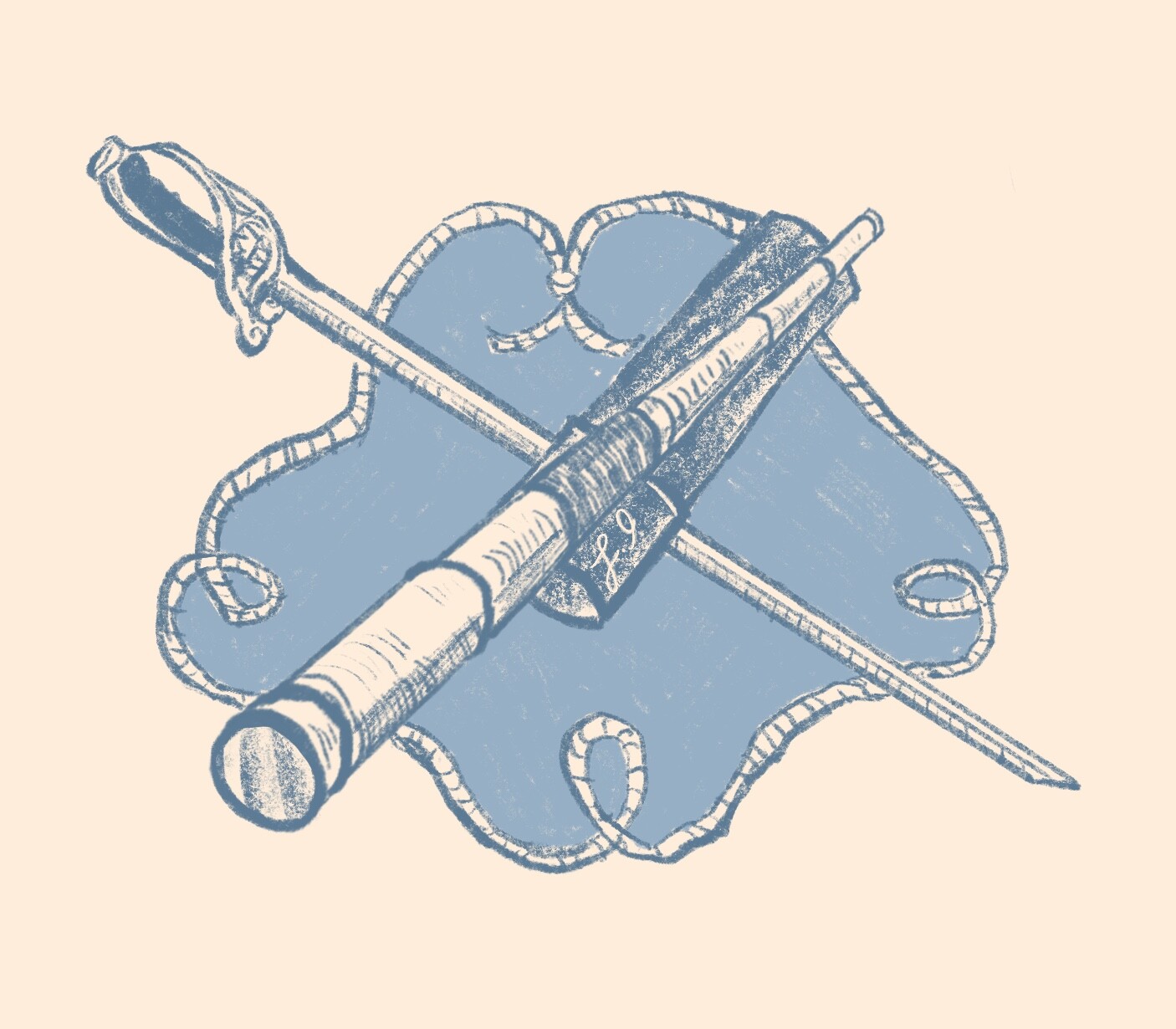
“You may have my glass if it helps,” John offers, drawing his spyglass from his belt and holding it out to Tozer. It’s the one he had specially made after accepting his first commission as a lieutenant, a fine six-sided glass detailed with ebony and brass, wrapped in leather and weighted perfectly to rest just so in the hand. It is one of his finest and most valued belongings.
“Won’t you be needing it, sir?” Tozer asks, tilting his head just a little.
“Oh—” John starts. “Yes. Yes, maybe. I’m sure your need is greater. For now, in any case. Well, should we set a time for you to return it to me then? Say whenever you see me next.”
Tozer, for some reason, beams at this. “Sure,” he agrees.
“Alright then,” John replies and pushes the spyglass towards Tozer’s large hands. “Take it. Use it. On a clear night, you may even have a good view of the stars.”
Tozer takes it reverently, as though he knows just how precious it is to John. His fingers don’t quite brush John’s—he is too careful for that—but John feels an imagined warmth all the same.
“Thank you, sir,” Tozer says, inclining his head in a small polite salute although the corners of his eyes are crinkled in a smile. “I’ll take good care of it.”
Tozer’s smile, next to that distancing title, has left John feeling strangely disarmed. Not knowing what to do, he finds himself wishing to steer the conversation to more familiar, neutral waters.
“Now, you mentioned wanting to know about how we read the chronometers?” And John starts to explain it, trying to ignore Tozer’s awed, amused grin.
The loaning of the spyglass to Solomon Tozer has one immediate effect— one that John will not admit ever crossed his mind when he made the arrangement: it means they now see each other at least once a day. Twice, if he’s lucky.
It quickly becomes a kind of routine. They meet first, just before the start of Tozer’s watch, when he comes to collect the spyglass from John’s cabin, and then again four hours later at the end of it, when he searches out John to make the return. This occurs without fail, no matter the hour. If the Sergeant ever wonders why John is awake at such quiet, sundry hours, he does not remark on it. He is only ever there, on schedule, spyglass in hand and a soft smile for John.
John likes routine.
There is comfort to be found in the sure knowledge of their meeting and of the exchange that takes place, fair and predictable just as John likes it. The spyglass for a few warm words, maybe even the lingering warmth Tozer’s grip has left on the barrel of the glass when John takes it into his own.
It is the certainty and surety of the routine that is so pleasurable: if it’s at the start of the day, there will be Tozer, squinting off into the bright blinding ice; and John, trying to look away from Tozer’s face, out at the ice, into the sky.
John likes it best when their rosters align enough so that Tozer returns the glass on Sundays, their rest days, preferably in the afternoon when most of the men are free of their duties, and John can sit in the quiet library, listening to one of Edward's music records with his watercolours arrayed before him. On one such Sunday, Tozer approaches him— without his uniform as though they are merely normal people in a park. Tozer’s hair is windswept and tousled as it always is on these rest days, his cheeks flushed with healthy colour from the games they play on deck, his undershirt surely damp with sweat despite the chill.
Yes, Sundays are his favourite, but all days are acceptable to John, really, so long as Tozer does come. It’s a sign that all is well if nothing else. Sometimes there is time even for some conversation, the spyglass lying easy and nearly forgotten between them, as though it isn’t the sole reason for their continued meeting.
Their conversations are both easy and oddly meaningful— Tozer’s sincerity makes John want to continue talking to him. Makes him believe that Tozer appreciates these simple moments as much as he does. It makes sense, John figures. The Sergeant is held apart from the rest of the men by virtue of his conscripted vows, just as much as an officer is by the chain of command, and perhaps it is this: the respective isolation of officer and Marine that offers them the space to converse somewhat openly. John finds him confessing things to Tozer he wouldn’t dare to his fellow lieutenants: things as trivial as memories from his childhood or something that’s caught his interest, the more severe matters of his struggles and loneliness, even the many and varied failures that littered his youth.
And sometimes, after such moments, Tozer looks at him a little too long, but John is determined not to notice this.
Just like how he tries not to notice that sometimes when Tozer hands over the spyglass, his hands linger a little too close to John’s own, close enough to touch.
2.
Nothing about their arrangement strikes John as queer until the afternoon he catches Gibson and Hickey down in the hold.
John knows he could have handled the entire sorry matter better than floundering and shying away like a nervous horse. He was a Lieutenant for goodness sake, and a man of God at that. There is no excuse for him to have been so unmoored when confronted with the—oh, he can barely bring himself to say the word.
Because what he saw— he cannot even stand to give it a name, let alone allow the images to reconstitute themselves and take up one more second in his mind. Even so, he finds himself too overcome to eat. For days, he forgoes taking breakfast with the rest of the officers to have coffee alone in his quarters, all to minimise the time he must spend with them: so much does he dread the prospect of seeing Gibson again, or worse, of having to speak of the matter.
If anyone questions him, then he might confess what he witnessed, but not until then.
It is made worse when Gibson corners him at last, and confesses the truth.
John hates carrying this knowledge with him; he is sickened all over again at the depravity of men, that they could have so little care for their own souls and those of others.
Even more than that, John hates that it haunts him, how it haunts him. How he cannot get Hickey’s sly smirking words out of his mind. That a man could subject another to that lasciviousness, and endanger his soul as well as his own. The images, like an occult curse, keep coming back to taunt him: the breathless way Gibson had tripped over his words, slickness still on his lips, the undeniable flush on Hickey’s face as he fumbled at the closure of his pants. And to think that all that time, Hickey had Gibson under his control, and had made him complicit in his sin.
But what he hates most of all is the shadow it has cast over his relationship with the Sergeant. What a mockery it has made of something that was so innocent and wholesome. The aspersions the incident has cast on the things they talked about, the laughter they shared, their friendship— could you even call them friends? Was that truly different from what Hickey and Gibson were doing?
3.
Despite his inner turmoil, John nevertheless manages to continue giving his classes. He is still helplessly pleased to see that Tozer attends, though more infrequently now, whenever his watch roster allows him.
One evening, Tozer waits once again for the rest of the class to empty before approaching John. John is not startled by this, not when it has happened several times before, Tozer waiting for him with a question: how a particular measurement is taken, how to calculate their coordinates on the map. It’s nothing a seaman wouldn’t know, but John likes Tozer's curiosity and dedication to deepening his knowledge of their work, even if he may not quite grasp all of it.
“No watch today then,” John says lamely, by way of greeting, if only to have something to say at all.
“No, no watch,” Tozer huffs.
“Thought I’d drop by for class anyway,” Tozer adds, almost hurriedly. He shuffles around and clears his throat. His next question sounds odd, rehearsed. “Have you had much use for it then? The glass.”
John’s hand flies to his pocket as a chill grips him. It only just occurs to him that he has been put into such disarray by the encounter with Hickey and Gibson that he has lost all sense of routine. He has not been in his cabin at their designated times, and after the first few missed appointments, Tozer must have taken John's absence as a withdrawal of his offer— a revocation of their arrangement. Oh dear.
“Forgive me, I have been… somewhat distracted,” John somehow manages to confess. “You will please let me know if you need the glass again, will you? If I forget again.”
“I’ve no wish to put my nose in what’s not my business,” Tozer says then, looking, to John’s eyes, more at ease. “But is everything well with you? Has something happened?”
John does not wish to talk about it, and not with Tozer most of all, and so he scrabbles to change the subject. His gaze flutters around and lands, of all places, on the sword strapped to Tozer’s belt. “What’s that there, at your hip?”
What it appears to be is a rather ostentatious sword sheathed in a gleaming leather scabbard. Its ornate hilt and its grip, wrought from pommel to base with exquisite brass ornamentation that swirls around it like a living thing, makes the sword looks far more like a piece of art than a weapon.
Tozer takes the sword in hand now, amusement and some sort of new gravity clear in his expression. “This? Got it in my tenth year, for service. Now I wear it when Sir John has one of his services like earlier— it’s too fancy for anything else.”
John, no stranger to accomplished men, hears what Tozer is not saying. He has seen Erebus’ Sergeant, and knows he carries no such sword. He hears the pride in Tozer’s voice now and understands now what the sword must mean to Tozer— how it must weigh on him. He can intuit enough from what Tozer has mentioned in their conversations, about his joining the Marines and his history of service since. But even without that, he could have guessed how enmeshed the Royal Marines are with Tozer’s own being. Tozer cannot be that many years older than him, yet he is already a leading sergeant, and assigned to a polar expedition at that— it is clear that Tozer is an accomplished man, and one does not carry such accomplishment lightly.
“I understand. I have a medal of my own too.” John does not know what possesses him to admit this—it is not in his nature to brag—but Tozer looks up, grinning.
“That so?” The interest in Tozer’s voice sounds genuine.
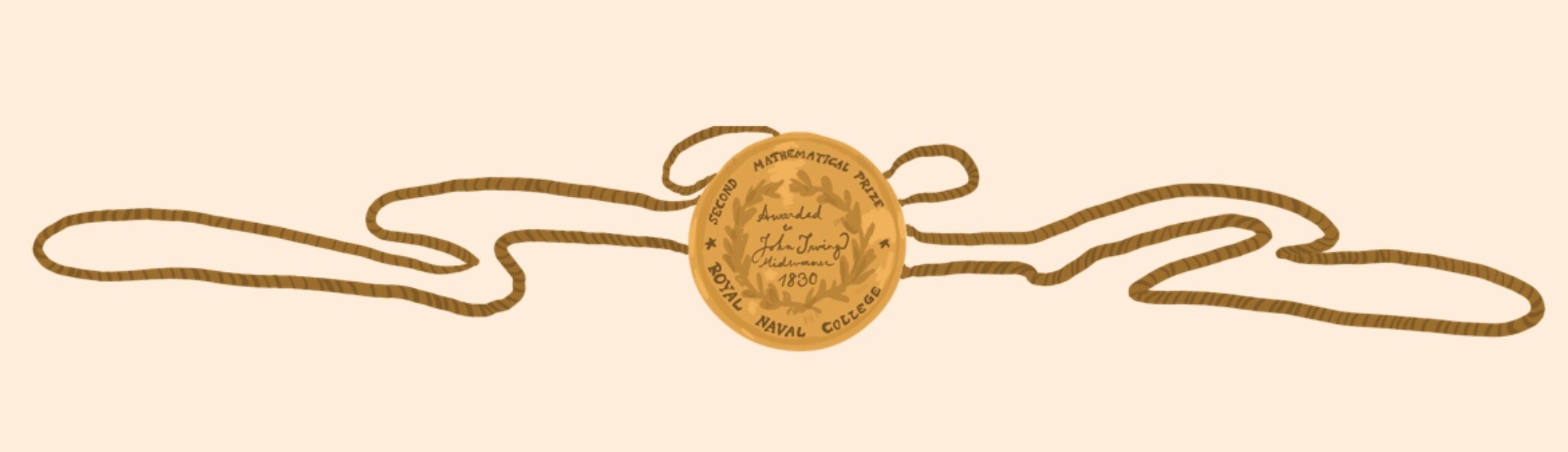
“F-for mathematics, yes” John stammers. “From a competition years ago when I was still at college. I was fifteen. It’s only silver, for second place—”
Saying it out loud to Tozer now makes him feel foolish. He realises what he must look like, clinging on to a mere child's trinket, carting it all the way here so many years later. But he had been so proud of it, hadn’t he— the only recognition he had of the one thing he was both good at and loved?
“One day you might show it to me,” Tozer says, kindly, and John can breathe again.
“It’s in my cabin,” John rushes to reply, only to wish he hadn’t noticed the way Tozer’s eyes sharpened at the mention of his cabin, and all the new intimacy it implied. John only just manages to restrain his gasp— might Tozer have misunderstood him? Might he have misconstrued John's comment as an invitation, an invitation to do what men like Hickey did?
But surely not. The Sergeant is an honourable fellow; John would be wrong to doubt him. The sword he had just been reflecting on was more than proof enough of that. There is nothing common between Tozer and that devious seducer that is Cornelius Hickey.
Even so, he cannot help but wonder about Hickey and what he had done to Gibson. How had he entrapped Gibson within his influence? How does it work? What urges could be worth the risk of what they did? He does not understand it — not the language for it, nor the actions they committed. What could be worth the risk of the human soul?
“Maybe when your distractions have left you alone,” Tozer continues. He has the tact to leave the invitation to confide in him unrepeated, but John hears it all the same.
John knows he cannot go on like this. It is irresponsible and unbecoming to do so, to desert his duties all because he is unwilling to confront the sins he had the misfortune of bearing witness to. He knows so little about it; he chooses not to know… yet he must. And as agonising as it is to give it a thought, he must discuss it with someone, and perhaps there is none better than Solomon Tozer.
But he has known Tozer—properly, he means—for all of nine or so months. Hardly anything.
“It is nothing of import, Sergeant,” John decides.
“If you’re sure, Lieutenant,” Tozer returns just as easily, and lets it go.
4.
“Came to give this back,” Tozer says one morning, and lingers. There is nothing odd about Tozer seeking out his company alongside the spyglass; they converse often enough now that it would be more strange not to.
Yet this morning feels different.
Tozer’s gaze settles uneasily on the expanse of ice beyond the gunwale. His fingers drum a restless beat against the wood. He’s holding himself tightly, almost rigid, as if with anticipation and apprehension.
With a startling shudder, John remembers: they are to hunt the creature today.
“Keep it,” John says, thickly. He can just about see the crevasse where the blind has been set up. His chest goes tight, and his throat clamps up, like he is choking on gauze, and he has to force the next words from his mouth. “It may serve you well on the hunt.”
Tozer stares at him for what must be a long, long moment. Nods eventually, and tucks the glass back into the pocket of his greatcoat without saying a word.
They are both quiet for some time. John feels a desperate urge to say something, but he cannot think of what could possibly be sufficient.
“Return it to me after,” John commands eventually, steadier than he feels. He feels… sick to his stomach, inexplicably so.
Tozer salutes him sharply, but with a smile this time, and turns to leave.
Silently, John watches him go.
John hears the gunshots before he sees the flares go up.
Is it strange that his thoughts go only and immediately to Tozer? When there were at least a half dozen other men out there with him, their Captain Sir John included?
No, no it is not strange, it is only natural. Tozer was the last one he spoke to before the hunt, so of course he would occupy John’s thoughts—
Another volley of shots rings out, closer now, followed by a man's screams.
Who is John trying to fool?
If anything were to happen to Tozer now, John would simply not be able to bear it.
It is wrong to feel relief that Tozer has returned—returned to him—unharmed when they have suffered so much loss. They have lost Sir John and a score of other men, including Tozer’s counterpart on Erebus, and the future of the expedition now spreads out blank and terrifying before them. But it is relief he feels all the same, when Tozer comes back.
“Your glass,” Tozer says when it is all over, somehow still remembering to seek John out. His voice is rough from use, his face drawn with exhaustion and fright. The hand that does not hold out the spyglass is stiff by his side, his fingers flexing and closing over empty air as though it hurts.
John feels stricken anew. He cannot find the words to comprehend what could have happened out there on the ice.
When John takes the glass back, he does let his hand cover Tozer’s and give his fingers a squeeze, because they are shaking; Tozer is shaking, and John wants to offer any comfort he can.
All thoughts have fled his mind; he cannot conceive of what he can possibly say, but it is the least he can do for the man he has come to know best, here, separated from the rest of the world.
For many days after that, John will repeatedly recall those few seconds when he had stood frozen staring out at the ice, having heard the shots and screams coming from the distance and not knowing if Solomon Tozer lived or died. For those few seconds, he had been both, and John had found the latter so unbearable it had paralysed him. That sickening blend of fear and dread had seized him like the jaws of that rampaging creature, an agony he had never felt before. How strange— everything in his life had felt so small then in the face of all that.
John cannot believe that now, not when their situation has become more precarious with the ships stuck in the ice, but in that moment, that is what it had felt like.
5.
Hickey’s punishment is brutal even by the Navy’s standards. John watches, sick to his stomach, as Hickey limps off towards sickbay, and thinks how the surgeon will treat Hickey with the same degree of grace as the other poor souls in there. John had once thought himself kind like that. He sees now how unforgivably naive he had been to believe that sparing Hickey’s crime would lead to his reform, rather than a more severe redoubling of his offenses.
But in what feels like the next breath, they are dealt another blow—an attack on the ship this time—and in the subsequent chaos, John has no room at all to think about it at all.
Days later, John is on the upper deck with Tozer, just wanting the cold air really, before they both go down. John is thinking absently about how Tozer’s face flushes red when he’s cold, like a dusting of translucent red paint across a damp page, when Tozer clears his throat and asks: “Lieutenant Irving, you are a man of strong faith, are you not?”
The question gives him pause. How does Tozer know? On the surface, he should not appear more devoted than any man on this expedition, especially not under Sir John’s command, so how could Tozer have discerned this about him specifically? Has Tozer been studying him? It is a disconcerting but not unpleasant thought. John has not felt easy in his skin, not since he was a child. But to be seen by this man here at the end of the world; here more than anywhere—
“Not so very much stronger than any other man here, I should hope,” John says, hoping his light tone covers the way Tozer has unsettled him. “But yes, I have always treasured my faith.”
Tozer nods, as though the answer has pleased him somehow. When he speaks, his voice is serious.“Do you believe a man has a soul?”
“Yes, of course,” John answers. The question was unexpected in its simplicity—Tozer might have asked him if he believed in the clouds!—yet he finds himself rushing to fill the silence when Tozer does not immediately respond.
“Though I did not think to find another man here so given to metaphysical thought,” John says, and that draws a small, if tired, smile from the sergeant, as intended.
“Not usually, no. Just—” Tozer’s eyes narrow in rare frustration. “It might be easier if you followed me, sir.”
“Of course.”
Tozer ends up taking him, almost gratefully, down the ladder, away from the cabins and through the men’s mess.
John knows where they are going, and who they are going to see, but not why.
Sickbay is dark and silent at this hour. Not even Dr McDonald is to be seen; probably asleep between his rounds. The rest of the patients do not stir.
“This is Private Heather,” Tozer says, although of course John knows of him from Dr McDonald’s grim reports in their morning briefings. It has been over three weeks since the attack; has Tozer been coming down here as faithfully as a husband for all that time?
For all his officers' training to mask all signs of weakness, the sight turns John’s stomach. The man lies inert in a grimy hammock, relegated to a secluded corner of the infirmary, out of everyone’s way. A thin cloth hangs from the top of his hammock, like a grotesque show curtain, shielding from view the gaping hole in his head, his exposed brain. There is what looks like candle wax barely holding his eyelids shut, but apart from that, his countenance is one of perfect peace.
“Heather, Lieutenant Irving’s come to see you,” Tozer continues, and John’s heart gives a painful twist. He manages to nod a salute at Heather, feeling both foolish and close to tears.
And then Tozer goes to his knees next to his fallen compatriot, and John could never have expected such tenderness from the Sergeant: the way he wipes down Heather’s pallid face, brushes his hair neatly back, clips his nails with care. It is ghastly to see it done to Heather’s motionless body, but still something stirs in John; it is that sight of Tozer’s large hands engaged in such delicate work, with so much devotion in his touch. Solomon Tozer, it seems, is a man of great affection.
Tozer draws back the makeshift curtain that shields Heather’s head for a brief second, as if checking that the wound may have closed up on its own. He pulls it back into place before John can see anything.
“So you see,” Tozer says abruptly, now done with his ministrations and getting back up to his feet. He meets John’s gaze squarely, with a small degree of hope in his face, one that makes John think he can offer him something. “Heather lives, but he doesn’t respond. Where do you think his soul has gone then?”
“I— I don’t know,” John starts, unable to pull his eyes away from how Tozer has crossed his arms across his chest, as though to hold himself, and how the way his large frame curled in on itself makes him look like a scared boy in need of comfort. Something stirs in him: the inexplicable, unreasonable impulse to be the one to offer it.
Tozer continues on undeterred. “The doctor says his head’s taken such a beating that what’s left is only enough to keep him breathing but not much else. If he’s still here, even with his body like that, then where does his soul reside, I wonder.”
“Perhaps in the heart,” John says foolishly.
Tozer chuckles, and pats Heather fondly on the chest. John realises that something aches in his own chest.
“Perhaps,” Tozer agrees softly, although he does not sound convinced. His gaze darts back down to Heather’s lifeless face and the curtain hiding his injury. Tozer takes Heather’s hand in his, giving it a sad unreturned squeeze. The pain in John’s chest grows sharper. All he can do is stand and watch. What is he doing here, he wonders desperately. Why has Tozer brought him here— for comfort? For truth? Both of which John is so ill-equipped to provide.
But dear God, John wants to.
“In all honesty, Sergeant Tozer, I cannot speak as to where his soul resides.” Tozer’s eyes snap up to look into John’s face now, and John steels himself to continue. “But what I can say for certain is that Private Heather possesses a soul, and that soul would be grateful to you, not just for how you treat him now, but as you always did— as his Sergeant, and as a fellow man,” John speaks in a rush, with a conviction he didn’t know he was capable of. “I mean, I’ve seen the way you are with your men. I know Heather would count himself blessed for having been with you. Whether his soul is here with him now—” and John thinks of the silent inert bodies in the dead room that are so like Heather’s, “—or with our Lord, in heaven.”
Tozer is looking at him, his eyes suddenly fixed and glassy. John is about to regret that comment about heaven when without warning, Tozer takes his hand. His grip is warm, and large, and very strong, and John can hardly breathe when Tozer presses their conjoined hands in a brief handshake.
“Thank you, Lieutenant.”
“I only speak the truth,” John manages. He can feel the beat of his heart throb all through his fingers, where Tozer holds him fast. “I am sorry I can’t offer you more than that.”
“You’ve offered me plenty,” Tozer says, roughly, and lets John’s hand go.
When Tozer next speaks, he sounds more uncertain than John has ever heard him. “Though I have been wondering. Could this be an act of God? Am I being punished?”
“What on earth could you be punished for?”
“I have sinned, you see.” Tozer’s tone is light but the tension in his face makes him look sad, almost frightful. Irrationally, John feels afraid. His mind goes again to Hickey and Gibson. But whatever it is he fears, he does not expect what Tozer confesses next.
“It was I who killed Captain Franklin; I murdered him just as much as that creature.”
“How? How do you mean?”
Tozer has folded his arms across his chest again, his fingers gripping his own forearms so tightly it must surely hurt.
“I asked the Captain to stay,” Tozer confesses in a rush. He exhales long and sharp, like he’s freed himself of a weight. “In the blind. He was going to go back to the ship and I asked him if he wanted to stay. If he hadn’t been there, he wouldn’t have… Well.”
The phantom echoes of those gunshots shake John all over again. Tozer’s logic is sound, yet—
“That was not your fault.” The fear has made John’s voice tight with force, though he is mindful to keep his tone hushed. “And who’s to say Sir John wouldn’t have been ambushed by the creature on his walk back to the ship? Far safer that he be with you and your men. You gave him a fighting chance.”
Tozer lets out a huge shuddering breath, the usual strength in his broad shoulders for a time appearing to break as his head sags.
“I am the last person on earth who deserves to hear that.”
“Listen,” John tries desperately, and then, as much as he hates it, reaches for the trained habits in the hopes it will snap Tozer out of the melancholy that has possessed him.
“Sergeant Tozer.”
The formality of his title in the previously quiet intimacy of their surroundings makes Tozer turn to him now, startled by its unexpectedness. John seizes his chance.
“I know you had no choice in coming here, and neither did Private Heather. Neither did any of your men. I know also that some believe that detracts from your honour or your bravery— but I think it makes it all the more so. To enlist and do your duty day after day, without knowing what you’re signing up for. You never know. You couldn’t have known.”
Tozer stares at him, something unfamiliar dawning in his eyes, like he’s been slaked of a thirst he hadn’t known he’d been harbouring. “Thank you,” he says.
“So you could not have known, Sergeant,” John repeats, as kindly and truthfully as he can. “In the blind, before the attack. There was no way you could have.”
“We cannot know everything,” John continues, determined, for some reason, to see Tozer’s spirits lifted. What else can he do to convince the Sergeant of his words? The worst sort of preacher was a hypocritical one, who would speak to the fears and concerns of his parish with no truth, experience, or understanding of his own— ah. He lands upon it. What he has been carrying all this while, without understanding.
“There is something I would confess as well, if you would hear it,” John says, as steady as he can. The conversation has left him feeling raw and open. “It is about what I was distracted with earlier.”
After John draws them away to the quietest corner of sickbay, furthest from the mess, he steadies his breath and tells Tozer the truth about Gibson and Hickey: what he had seen, his suspicions, Gibson’s confession and accusation. Tozer, to his credit, listens calmly throughout. Even as John stutters and stammers just to give voice once again to what he saw, Tozer does not push him.
Tozer exhales when John’s account draws to an end, scrubbing a hand through his neat hair. There is no mockery from him, as John had feared.
“Such situations are not uncommon in the Marines,” Tozer says thoughtfully. “But the accusation is a severe one. And if you’ll let me be forward, I would not put much weight behind what Billy Gibson is claiming.”
“Do you think so?”
“From what I’ve observed?” He jerks his head towards the direction of the men’s mess. “Yes. Fairly confident.”
John flushes. “I see. Did you not think to report it either?”
Tozer watches him carefully. “As you know, we watch out for a good lot of things here. As far as offences go, what two men do willingly—in their own time, without hurting nobody else—is the least of my concerns.”
Even John can appreciate the risk Tozer is taking by telling him this. “I see,” John says quickly. “I could not bring myself to report it— perhaps it was that. I wish I had mentioned it to you when I first saw it, now,” John admits, relieved to have reached the end of it. “But that is not the issue.”
“What is, then? What’s worrying you?”
Tozer’s calm, measured tone is encouragement enough for John to be honest.
“The issue is I now find myself wondering what might it feel like that it would tempt men so. Not everyone here is as... understanding as you on these matters, I'm sure. So what might have induced them to take that risk in the first place?”
Tozer does not immediately respond, which is a blessing.
“I have done my readings,” John continues. “I can find nothing that offers any clarity.”
Tozer says nothing for a while. His jaw works as he thinks, but his eyes are sharp, considering. “If you like,” he says slowly and very carefully. “I could show you.”
John’s first instinct is shock, followed by a quick flush of anger. But he catches himself—the long hard months have taught him temperance and instilled in him more tolerance than he thought himself capable of. He remembers Solomon Tozer is not that kind of man. Solomon Tozer is kind, and thoughtful, and honourable. This offer cannot be made in anything but good faith, though John still wants to make sure.
“What do you mean?”
“I mean I could be your partner in these explorations. If you want to know what it is that men do, and why they do them— should you not try it for yourself?”
“Readings,” Tozer adds, a small smile on his face now, the first John has seen all day. “Might only get you so far.”
It is further testament to how much John has changed that he is able to give this suggestion any thought at all. Perhaps it is also the cold, and the long hours of darkness that have eroded his restraint. Tozer’s offer may never come again. How many men were there that John could truly trust? What Tozer was proposing was no different from an experiment, an effort to further one’s knowledge and understanding, and so there could be no sin in it.
John nods. He holds Tozer’s gaze, feeling the weight of his sincerity.
“If you would oblige me, then yes. Yes, I would like your help.”
6.
The day they are to meet comes sooner than John is ready for, but he doesn’t think one can ever be ready for something like this. There’s nothing for it now but to charge ahead.
They both meet without acknowledging the other, and begin their march separately towards the officers’ cabins. If anyone thinks it strange that the Sergeant of the Marines might be trailing John through nearly the entire length of the ship, nobody speaks up. Tozer, he supposes, has that way about him. They are silent themselves, and it’s only when they have reached John’s cabin, Tozer arriving a few minutes after John, and have slid the door shut behind them, that Tozer finally turns to look at him.
Tozer appears perfectly calm. Unruffled, as though there is nothing out of the ordinary about what they are about to do. Which is just an experiment, John reminds himself, even as his blood begins to quicken in fear. Just a study.
They don’t have the luxury of time here, so it must be only a few minutes that pass. Yet it feels like hours to John, and the longer they stand there not speaking, the more unbearable it comes to be. John has never minded the cramped nature of his quarters; his years as a midshipman are still fresh in his memory, and he is more than grateful for the walls of his cabin, a private enough place he can retreat to. He has found its small size comforting even, the walls a mere arm’s length away, the washstand and narrow desk beside him, to be so securely tucked up against the corners of his cabin.
But now with Solomon Tozer standing in here with him, it suddenly feels like it is far too little space.
Finally, because he must, John breaks the silence.
“Were you seen?”
Tozer rustles around his coat pocket and pulls out his small notebook, waving it around with a grin. Easy, unruffled. “Brought my sums. Made sure anyone looking saw me frowning at the exercises here. Now they’ll think I’ve come for a class.”
“In a sense, you have,” John replies, though he has no idea why. His unthinking comment earns him an amused huff from Tozer, and when John looks up, he sees he’s grinning even wider. Something flips around helplessly in John's chest. His mind makes a desperate leap towards absurd social habits, flailing for the old scripts he has now memorised by rote.
He reaches past Tozer for his personal supply chest beneath the bed and busies himself with fetching the fine China plates and silver within, grateful for the work to distract him from Tozer’s gaze.
“I could not call the steward,” John manages to say. “So I have nothing to offer you to drink, and neither do I smoke, though I do have some chocolate.” With how long they have been at sea, there really aren’t many left now, but John still picks up two foil-wrapped squares and holds them out on a plate to the Sergeant. “If you like.”
Tozer has a smile on his face; the corners of his eyes crinkling with a degree of amusement and fondness that makes John quail.
“I am to be spoilt today, it looks like,” Tozer says good-naturedly, as he accepts one of John’s chocolates. He leaves the other and the plate, presumably, for John.
John tries not to stare at Tozer's fingers unwrapping the chocolate. He flounders instead for a response, for something to say.
Tozer saves him, but not before placing the entire square of chocolate in his mouth. It did look very small in his hands; John should have offered him another. He still could. But before he can, Tozer grins at him and says, “Shall we?”
Here it is then: the boundary to cross. John should not fear what is about to transpire, yet he cannot yet bring himself to do it. He takes a deep breath, and finds it steadies him. This was not a task he was doing out of lasciviousness or in pursuit of pleasure— he only wished to make a study, he reminds himself again, an inquiry in the name of faith or morals or whatever one wished to call it. It was nothing more than an experiment. One did not begrudge the naturalist his hordes of dead specimens, or the anatomist his cadavers for that matter, and so what fault could anyone find in what he was about to do? What sin?
“Second thoughts?” Tozer probes. Gentle, always so gentle, his throat working as he swallows the chocolate. Gentle enough that John knows he need not fear anymore.
“No,” John decides.
“Good.”
Good? Why would it be good? Is Tozer so invested in this study as well that John backing out now would be bad? But before John can dissect those thoughts any further, Tozer is moving them along.
“Just to be clear— You want to gauge what could induce men to… bypass friendship, yes? And what they do? What acts they might… engage in?”
“Yes,” John stammers, feeling his face heat at the terms of their study being so laid out so matter-of-factly. “That would be— that is helpful.”
Tozer nods. “Right. I thought I might show you all that, so you could try to understand. Having experienced it yourself, I mean. How should we do this then? I could touch you first, just on your arms and hands to start.” Tozer’s voice is calm and steady, the sort of voice one would use to soothe a spooked horse. “And then if you want, we can do more.”
John can only dip his head in assent. He feels suddenly over-aware of everything in this small space, the thin walls and Tozer, all closing in on him.
Seconds later, Tozer’s hands land, friendly and unintimate, first on his shoulder.
“Alright?” Tozer’s voice is so soft and so gentle, far softer than John ever thought him capable of, as wondrously baffling as the tenderness John had seen from him by Heather’s bedside.
John nods, breathless, wordless. It is alright. This is normal. There is nothing untoward about this sort of contact.
And then Tozer sweeps his hands gently down John’s upper arms, pausing only to give his elbows a light squeeze. Still alright, John nods. Encouraged, Tozer lowers his hands further. All this while John has been protected by his sleeves, but now Tozer’s hands are fast approaching his own, and soon he will feel Tozer’s bare fingers touch him, the first time he has felt anything like that, and suddenly it is skin against skin— Tozer’s fingers trail across his wrists, and John gasps.
Tozer halts immediately.
“No?”
John shakes his head. Tozer begins to pull away and John’s heart leaps in alarm. No, that is not what he meant. He starts to shake his head again, but then corrects himself and speaks instead. “No, continue,” he says. “Please.”
Tozer smiles at him, his easy crinkling smile, and places his hands on John’s wrists again. It is somehow nothing at all like the handshake Tozer had given him in sickbay, and he cannot begin to understand why.
“You’re nervous,” Tozer observes, perhaps feeling the frantic kicking of John’s pulse beneath his skin. “You can tell me to stop, you know.”
He keeps offering John an out, John thinks in despair. Can John not even be trusted with his own feelings?
“I will tell you if I need to, Sergeant, please.”
Apparently appeased by this, Tozer’s fingers resume their movement, moving ever lower to find John’s palms. John’s breath catches— he has never been touched like this. His own fingers seem to spasm, and are unable to resist closing around Tozer’s. John spends what must be a long moment staring, trembling, at their joined hands.
It’s warm. The heat even seems to tickle, in every place their skin meets. John dares to look up, only to see that Tozer is still smiling, and the smile turns even more fond now as he links his fingers properly with John’s.
They stand, unmoving, hand in hand, holding fast to each other. The sensation is… strange. John feels buffeted by a sudden storm, as though all the rest of the world has ceased to exist; as though everyone he knows or has ever known or will ever know has paled into the shade, not one of them a match for this: Solomon Tozer’s hand in his.
Why does his hand feel so small, clutched between Tozer’s? He thinks he feels his heart beat right there, where his fingers are caught against Tozer’s, from the gentle pressure of his touch. It’s so warm where their skin meets, and even though it is only John’s hand that is enveloped in that curious heat, he feels it wash gently all throughout his being. It’s the warmest he’s felt since they set sail.
Just then, Tozer squeezes his hand ever so slightly, and John feels his heart plummet. A desperate thought flares to the front of his mind, unbidden.
How can this be sin? How could he have ever thought that?
His despair must show on his face, because Tozer clears his throat lightly.
“I’ll try something else now. Remember to stop me if you need to,” Tozer says, low. John already knows he will shake his head. No, he corrects himself from what he thought earlier. This is no different from a handshake. No, there is no reason to stop, there is no reason for his heart to be beating as fast as it is.
But then carefully, slowly, as though not to spook him, Tozer raises their joined hands higher and higher until they are nearly level with his face. You must stop me, his eyes seem to continue to say, fixed on John’s own.
John has no intention of stopping.
Their hands are so very close to Tozer’s mouth now, close enough that John can feel the warm puffs of breath against his skin. When John still makes no move to stop him, Tozer brings John’s hand to his lips. John can’t believe what is happening, but it is drawing close so it must happen, it must; and then it does happen— Tozer’s lips are on his skin.
It’s just a simple kiss, barely anything. Tozer’s lips are soft and dry and unbearably gentle against John’s white knuckles. Tozer keeps a careful hold on his hand even as it trembles, drawing his lips away after that solitary kiss. It had been chaste enough that it could mean anything; a kiss from disciple to teacher; from servant to liege; from a son to a father; from lover to lover.
But John does not feel like a teacher or a liege or a father. The quaking of his spirit does not feel like that at all, a realisation that makes him whimper.
Something flares in Tozer’s eyes, as quick as a struck match catches. But it fades just as fast, replaced by a look of concern and uncertainty.
The truth is that one kiss alone, the touch of his lips against the back of John’s hand, had been enough for John to imagine Tozer’s lips on other parts of his body. He shivers as a wave of affection and trust floods through him, overcome suddenly by affection for this man who is so open with his compliments, as earnest in his speech as he is in his studies, in his search for the soul.
“You can touch me more.” John’s voice is barely a whisper. Tozer only nods, the uncertainty in his gaze replaced by a quiet confidence. “Please.”
Tozer moves faster than John expected, taking his hands away from John’s and resettling them on either side of John’s shoulders. Slowly, almost imperceptibly, Tozer pulls John towards him. There can be no doubt as to what is coming next.
John lets it.
Tozer places a kiss on his forehead, like a benediction, then on his cheeks, both sides in turn. Such a simple act, yet it sends a wave of giddiness through John, like the tide sweeping away the sand beneath his feet.
“I feel that I may faint,” John confesses, when it passes.
“I’ll catch you if you do,” Tozer replies, grinning. And then, with the same tenderness with which John saw him tend to Heather, Tozer reaches out to brush John’s hair back from his clammy forehead. “But I’ll see to it that you don’t.”
It is so intimate. Again, John finds himself entranced by the delicate work of so large a body.
“Shall we stop for today then?” Tozer offers softly. His voice is gentle; free of any offense or judgement.
Should they stop? They’ve come far enough, surely, but— but not enough. What they have done so far seems miles yet from what was taking place down in the hold, in that fetid place of rats and dirtiness. And John simply must know, mustn't he? He must understand, and to understand, he must first experience. And when would his chance to do so ever come again? It was hard enough to find a partner as understanding and honourable as Solomon Tozer, and harder still to find a time when they would both not be missed from their stations. Not to mention the officers’ cabins were rarely ever this empty. So should they stop? Now, after all they’ve done? That gives him pause. What else, then, can they do? The question, and its many answers, thunder through him.
“No,” John decides. “We can continue.”
“Sure you’re well enough?”
“I am sure, Sergeant,” he returns, maybe a little sharply.
If he has taken offense at John’s tone, Tozer does not show it. He is ever the perfect soldier, John figures, but he has little time to dwell on that thought because Tozer reaches out for him again, and for some blasted, sorry reason—perhaps it’s merely how unprepared he is, or perhaps his nerves haven’t settled from the previous excitement—John flinches.
Tozer draws back properly. “You are certain you’re alright?” He asks, firmer now. Even so, there is still no judgement or unkindness in his tone.
“I think,” John says, when he has wrested his senses back under control. “I think we ought to stop for today.”
Immediately, Tozer pulls his hands away from John, clasping them out of view behind his back, and John feels inexplicably, unbearably cold in their absence. The shock from before was preferable to this.
“Of course,” Tozer says, polite and obliging as anything. What now, John wonders. Might Tozer now turn heel and leave? The prospect is, somehow, unbearable to John.
“Ah— you wanted to see my medal, didn’t you?” John scrabbles for a conversation topic after some agonising moments of silence. “Let me fetch it for you, since you are here.”
Without waiting for a response, though he is sure Tozer would reply in the affirmative—Tozer has never denied him anything in the duration of their acquaintance—John reaches for the wooden box on the shelves overhead. How many times has he done this, drawn the medal out and gazed at it as though it were something more than a school prize awarded to a mere boy, as though it means something here? But he had been proud of it once. Recently, however, it has not been pride he feels looking at it, but a yearning. For easier, more painless days, days when one’s proficiency in mathematics was all that was needed to be awarded a place in the world, to be afforded recognition.
John swallows the sudden lump in his throat.
“Here it is,” he says, staring at the simple pressed metal trinket and not daring to look up at Sergeant Solomon Tozer, who owns a sword given to him by the King for his bravery and honour.
“It’s beautiful,” Tozer says, and John’s gaze snaps up against his will only to see that the look on Tozer’s face is entirely sincere.
That night, John reaches up for the box again. He opens it to gaze at the medal within, seeing it with new, grateful eyes, as though seeing it for the first time once again.
The next time they meet, it is Tozer who lies back and lets John do anything he wants to him.
“You can’t just be on the receiving end of it all,” Tozer had pointed out matter-of-factly in the snatch of time they had had when John approached him to suggest a continuation of their experiment. “Won’t do you no good to just have things done to you, and not know what it’s like to be doing the doing.”
John had felt the blood flare in his face at the suggestion, but found little to disagree with. It helps, somehow, that Tozer is so proper and so business-like about the whole thing. It is an apt reminder that this is a study, an arrangement between friends in pursuit of the truth, for the betterment of John’s own judgement.
Now, Solomon Tozer is before him, sitting on the edge of John's bed as demure and quiet as a lamb.
Realising he has no idea what to do, John only mirrors what Tozer had done to him before: starting by placing his hands on Tozer’s shoulders, he runs his touch down Tozer’s arms and finding them, to his curious delight, as solid and strong as they looked from the outside. Tozer’s gaze rests easily on his face as John focuses entirely on the feeling of wool beneath his fingertips. He skims his touch carefully over Tozer’s coat lapels, choosing to direct his attention to the cold metal of the buttons rather than the warm body that lay beneath.
There is no going back now. He cannot abandon Tozer’s generous offer and simply flee. There is nothing for it, so he undoes the buttons he had been staring at. There are many layers of fabric beneath the coat, and John loses himself for a moment in the symphony of textures as he pushes each one out of the way: the dense wool coat; the soft, almost damp cotton of his shirt; the catch of his undershirt against the skin of his fingers.
John marvels at Tozer’s body. Any man would. There is a strength to him that appears effortless, like an afterthought; as though he had always looked like this. He seems almost larger out of his uniform than in it. Even in the dim light, John can see how Tozer’s well-muscled figure glows with health. John cannot stop admiring the beautiful colour of his skin, such a perfect compliment to his sandy hair, and he feels a sudden awareness and awkwardness of his own pale, soft body. John is thinking only of this as he runs his hands down Tozer’s body, slipping them beneath his loosened shirt, admiring the solid bulk of his torso and how it narrows neatly into the waistband of his breeches.
Quite without notice, Tozer moves, pressing himself into John’s touch with a half-bitten back groan, like he’s in pain. John leaps backward, pulling his hands away.
“Sorry,” Tozer says a beat later, his voice a rasp, snagging on the silence between them.
John frowns through his blush. “Is it always like this?” So fraught, he means. Where each little touch could draw such a reaction.
Tozer is quiet for a long while before he replies. “No.”
Oh. Why had John needed to know? Why had Tozer’s answer sent a lancing brightness through his breastbone? He doesn’t know what to do with the answer, or why he had even asked in the first place.
“You can carry on,” Tozer says then, gently encouraging. He hesitates. “Might be easier if I lie down.”
“Alright,” John agrees.
The sight of Tozer lying back in John’s narrow bed is more disconcerting than John could have prepared himself for. Tozer’s eyes, always so dark, are now caught by the light, so John can make out the flecks of colour in them and the shadows cast by his long lashes. It’s an arresting sight, and John finds himself at a loss for what to do. He has replicated all of Tozer’s actions from before and now is uncertain of what follows that would not involve him stepping right into the deep. There’s one thing he can do, he supposes, that’s safe enough.
He leans forward, his heart leaping into his throat, and places a kiss quickly on Tozer’s cheek, as he might do to greet a friend after a long separation— only a friend would not be laid out in his bed with his buttons undone, looking at him with such dark, trusting eyes.
It’s embarrassingly clumsy; and John blushes and trembles even more than when he was the one being kissed, yet a low sound of surprise slips past Tozer’s lips, involuntary and somehow unspeakably precious.
“Sorry,” John startles.
“No, you’re fine,” Tozer says hurriedly, but John can’t help but notice how the bed covers have twisted with the strength of his grip.
The way Tozer had sounded and looked at him clings to his mind. John never imagined he could have such an effect on someone— someone as accomplished and assured as Solomon Tozer, at that, and over as something as chaste as a peck on the cheek. It was chaste, wasn’t it? Surely it was.
Yet before he knows it, John’s mind is conjuring all manner of foolish, indulgent things, things he has never allowed himself to think before. Things like Tozer in a proper bed instead of the cramped bunk of his cabin, in something far more expansive and more luxurious, with soft sheets and down pillows in which to lose themselves. Tozer saying his name so that John will turn to him; Tozer in the morning light of summer; Tozer’s warm and brilliant smile.
They are incessant, these thoughts. Bad enough if they were errant daydreams to while the time away. But they scarcely ever leave him alone, not even when he is absorbed in his duties. It’s testament enough to how much he has lost his reason over this that he does not stop to wonder about Tozer’s selflessness in volunteering himself up for John’s experimentation. That is just the kind of man the Sergeant is, John reasons.
When he encounters Tozer again, even if it is just the brief yet inevitable crossing of their paths during the course of duties, or simply catching a glimpse of him from a distance, he is unable to keep the ghost of these imaginings from rushing to the surface. How can he possibly reconcile this bright, shining, immaculate Sergeant of the Marines with the dark-eyed, undressed man in his cabin who had held his hand, and had flinched at the touch of John’s lips on his cheek?
John cannot quite verbalise the things they have done. He may never be able to. Yet surely some part of those passions must show on his face, because something in Tozer's handsome expression grows sharply intent, like hunter’s eyes, when he sees John again.
Maybe it is that creature’s latest attack, once again aboard the ship, that has unmoored him enough to destroy what little is left of his rational mind. The horrific violence; more bodies in the dead room; the captain and the ice master indisposed; and—for the first time—Tozer had not emerged from this untouched.
Hours later, when the ship has settled as much as it can, John searches Tozer out, the fright and shock still surging through his body, remembering what it was like to be trapped below, frozen with fear, hearing the creature’s horrendous bellowing and knowing Tozer was once again right there with it.
John finds Tozer at last in the driest part of the orlop, taking shelter in the shade of some storage casks. John approaches and promptly stumbles over his greetings. Even though he had known of Tozer’s injury—a mistake with the cannon, he’d heard from one of the men, when he had pressed them for details—and is not surprised by the bandage wrapped around his wrist, he hadn’t expected Tozer to look so drawn and grey.
“Your hand,” John starts unhelpfully.
Some of the colour seems to come back into Tozer’s face.
“Just a small thing,” he replies, quick, almost brusque. Then he seems to catch himself and softens his tone. “Nothing compared to the others.”
“Of course. I did not presume to—”
Tozer does not let him finish his apology. He places a hand on John’s forearm to still him.
“I know,” Tozer says, more kindly than John thinks he deserves after the favouritism he had come so close to showing. “I know what you mean.” A pause. “Did you need me for anything?”
How has he been so easily caught out? Confronted by the request, John scrabbles and fails to come up with a lie.
“Forgive me for asking,” he starts thickly. Even before John can continue to speak, the doubts beset him. Why is he asking for Tozer to see him? Why does his investigation still matter in the light of everything that is happening around them? Does it even matter? John’s head aches terribly.
“There is nothing to forgive,” he says roughly.
John quails at the sharpness, and Tozer, of course, notices. His expression and tone both soften. “Is something the matter?”
“I was rather short with Manson earlier,” John confesses. “When we were putting away poor Mr Hornby.”
“I heard,” Tozer says simply. John feels himself flush. It is one thing to confess his mistakes directly to Tozer, but another thing altogether to learn that Tozer is already aware of it from a different source, might have already been thinking about it on his own, forming his own judgments and opinions of John.
“Lad came up to the mess shaking all over,” Tozer continues. “He got an extra cup of cocoa from Mr Diggle for that.”
John shrivels. Is this reproach from Tozer? Does Tozer think him abhorrent now? But there’s no revulsion or disdain in Tozer’s manner. Just a wealth of patience. A clear statement of the facts. Tozer’s fair and level judgement. Still, John wishes to make his case. It comes out in a rush.
“I ought not to have lost my temper. I know. Only— only he was going on about such blasphemous things, and refusing his duties, my orders, because of it. I could not simply let it go. The last time I was so lenient with a man, he paid a far more severe price than whatever discipline he would have faced had I intervened when I was able. In granting him what I thought was clemency, I failed in my duty to him, I admit it now. I’ve sworn to never let it happen again.” John takes a steadying breath, and faces Tozer fully. “So what would you have done, Sergeant, in my place, if it had been one of your men…?”
Tozer considers this, and when he next speaks, his voice is level and calm. “I see why you think as you do, Lieutenant. But there’s many steps between clemency and a bollocking.” John flinches at the language, but Tozer steers the conversation away smoothly and without apology. “Though I wonder, is this really what you came here for?”
“No,” John admits, subdued. “I came to see how you were doing. If you were alright.” He stops, and tries to calm himself before he says what he really intended to say all along. “And if you had the time to could come to my cabin. When you are able.”
Tozer grasps the implication immediately. He draws himself up, held tight like a hunting dog. “I do have the time," he says. “If you do.”
Hours later, Tozer slips into his cabin. He doesn’t knock; he doesn’t have to.
John had shed his coat as he entered the sudden damp heat of his cabin, but now he feels exposed in just his vest and shirt sleeves. Thankfully, Tozer doesn’t seem to notice— he had been uncharacteristically graceless, almost harried, in coming in. When he’d reached for John to seat him on the bed, he’d almost stumbled. It must be the injury to his hand that makes his movements so clumsy, John thinks. The effect, so unexpected from Tozer’s usual calm and control, is unexpectedly thrilling, even though the sight of the bandage is unsettling.
It’s an awful reminder of how it had felt in those terrifying moments he’d spent locked below, tormented by the knowledge that Tozer stood above, exposed to the creature. Just like that time when Tozer had been caught out in the hunting blind, when those first few shots and flares had gone up and all John could think of was whether Solomon Tozer lived or died.
John’s mind keeps returning to that hypothetical loss now, weighing the fear he’d felt against the unbelievable sensation of Tozer’s heated skin against his, and the jarring dissonance and relief of the two sensations is so powerful that he cannot help the pathetic whimpering escapes him.
Distressingly, Tozer’s response is to gather him into a rough embrace before lowering him down onto his bed.
John finds himself laid open on his back, blinking up at Tozer, hoping he doesn’t look as overcome as he feels.
Tozer says, simply, “Would you let me touch you?”
Almost as soon as John nods, Tozer’s large hands deftly undo the buttons of his vest, loosening the shirt beneath. And then he is pushing off the vest and tugging the soft cotton shirt up, so John’s skin is exposed to the air and his eyes. Tozer’s eyes settle on him, taking him in as though he has all the time in the world for it.
What could Tozer possibly be thinking, seeing John like this? He tries to imagine what he might appear to Tozer: the softness of his body, white skin, the oh— oh! the cross around his neck.
What Tozer does think of him, he’ll never know. Tozer is propped up over him, saying nothing, taking it all in. John is awash with an unfamiliar sensation of safety, bracketed in by the sturdiness of Tozer’s limbs and the frame of his body. It is the complete opposite of how he had felt earlier, terrified and trapped below, that John lets himself reach up and touch, allows his palm to rest against the line of Tozer’s jaw. Tozer holds himself perfectly still, perfectly tame throughout. John thumbs gently at his fine cheekbone, almost disbelieving. Tozer is alive. He is alive. And they are in this space together.
As though emboldened by John’s touch, Tozer lowers his head and presses his lips to John’s neck, delicately avoiding the cord that holds his cross. It hits John like a lightning strike, and John shudders at the unfamiliar sensation of being touched there. It’s ticklish at first against the surface of his skin, but then, quite suddenly, the feeling burrows deeper, leaping into his veins and then all he feels is the heat beneath it all, and the dull throb of pressure and pain as Tozer nips at him with his teeth.
John can’t help but cry out, and against his will, his hips jerk up to meet Tozer’s. Tozer utters a low appreciative growl at that— though it is stifled, as if he cannot help it either.
Somehow Tozer finds the sense of mind to ask, “Alright?”
“Yes,” John manages to gasp. “Don’t stop,” he says, and Tozer obliges, pressing yet another kiss to his throat.
Tozer is kissing him properly now— not on his mouth or his neck, but on his body, on the embarrassingly soft pale expanse of his belly, softer than any officer had any right to be, he knows, but Tozer kisses him there anyway and he hears Tozer say—
“You’re beautiful.”
“Please don’t make fun,” John says, dismayed, distressed, and sitting up.
“I’m not,” Tozer replies, and to make it worse, John sees from his eyes that he really is not. Soothed but still feeling disconcertingly unraveled, John lies back down again. Only Tozer doesn’t seem ready to let it go.
“You’re terribly pretty,” he insists, frowning down at John. “Surely you must know that.”
“Nobody has ever said that to me before.”
“I’m saying it now. You are a beauty. What a gift you are.”
And John has no response but to accept it. Tozer has never been anything but unfailingly honest in their time together. But as if his words were not enough, Tozer continues to anoint him with kisses, moving all the way up his abdomen and his chest before sweeping back down to the hollow of his hips. John feels every kiss Tozer presses to his bare skin, each one sending a tight stab of anticipation and a strange flickering through his body, magnified by the echoes of the fear he had felt earlier. Still, he’s aghast at the audacity of his own body, at its over eager response to Tozer, at the fierceness of feeling that rises in his breast as though called to the surface by each of Tozer’s kisses.
Tozer has kissed him so many times that John has lost count. One of John’s hands is tangled into the bed covers, the other thrown over his mouth in an attempt to stay quiet. But Tozer is kissing him, still kissing him, the softness of his lips and the gentle tickle of his beard making John squirm and quiver against him.
And what can John do but close his eyes and give himself up to the worship Tozer is offering him? Are they not all creations of God? And if Tozer chooses to give praise to such a creation, it is no less than giving praise to the Lord directly.
He thinks he hears Tozer say something again, but he can’t make it out, and he’s trying his best to stay conscious and in control before he loses himself entirely. He wraps his arms around Tozer’s broad shoulders, clinging to him like a child, as though Tozer could keep him anchored amidst the storm of his emotions—joy, fear, anticipation, excitement, disbelief—but more than all that, gratitude; gratitude, so overwhelming it makes his eyes sting, that Tozer is still here at all.
“Sometimes I wonder what it would have been like if I had been born in a different time,” John sighs later. The emotions that always seem to follow his meetings with Tozer have caught up with him now, tugging belatedly at him like the wind in the wake of a storm, always the worst in the minutes before they have to part and return to their normal duties. A panicked pain rising and scrabbling out of his chest; strange regrets he might never have acknowledged otherwise; a melancholy that leaves him hollow and aching, made all the worse tonight because of how he had mistreated Manson. “A century from now. Maybe even two.”
Tozer hums, weighing the confession. What John has just offered him. “Wouldn’t have met you then, would I?”
John is stunned. “No, I suppose not.”
“Well, then,” Tozer says, pleased, like that’s the end of it.
There is nothing wrong, really.
It has become a common enough refrain: John reminds himself that there is nothing wrong in what he and Tozer are doing. Tozer is a friend—a good friend, he might even dare to claim. Though he barely knows the meaning of the word, Tozer must be it. Why else would he take such an interest in John’s concerns? And affection between friends is to be expected, encouraged even, especially here where they are apart from all other company.
Even when he wakes up, blinking and bewildered and unaware he had ever even fallen asleep in the first place, somehow encircled in Solomon Tozer’s arms, trapping Tozer against the bed with the weight of his head, he tells himself there is nothing wrong with it; nothing wrong with keeping warm, nothing wrong that he should be tired from their exertions. Yet when he pulls himself upright, stumbling over his apologies for being presumptuous enough to keep the Sergeant from his duties, he cannot explain what could possibly cause Tozer to look at him like that, staring at him as though struck by wonder.
7.
The days seem to grow even darker as Christmas approaches, and though ripples of excitement begin to spread through the men below, there is unsurprisingly little festive spirit in Terror’s command room with Captain Crozier having been laid low with his mysterious ailment.
Even so, it is not enough to stop John from seeking out Tozer again.
“I was wondering about something, Sergeant,” he begins.
Tozer nods, understanding as always, and moves them along in their familiar way to John’s cabin. They have done this so many times by now that they go by rote. This time, Tozer takes the liberty of seating himself on the edge of John’s bed and beckoning him over. John is delighted by this new ease, even as he notes with a strange ache that Tozer’s hand is still bandaged. Surely a wound like that should have begun to heal by now—?
But John has come within touching distance now, and Tozer pulls him gently by the hips towards him until they are standing knee to knee, John a few breaths away from being fully in his lap, and there is no time for thoughts. At this unfamiliar angle, John is looking down at Tozer while Tozer’s face is upturned to meet him. Strange how that makes him feel, that such a simple change of perspective can set his heart to thundering, but he has long stopped questioning the peculiarities of his reactions to Solomon Tozer.
“Hullo,” Tozer says, in an overly affected tone, and John hears his smile more than he sees it under the dim lamplight.
“Good evening, Sergeant,” he returns primly. John can play along at whatever this is. He feels his own cheeks stretch in a smile of his own as the corners of Tozer’s eyes crinkle at the sound of his voice.
Tozer runs his hands up from John's hips to rest on his chest. Weeks ago this would have startled him, but now this touch from Tozer has come to feel natural, and he luxuriates in that knowledge.
“May I,” Tozer mutters, his fingers just skimming John's collar. “Did I hear you say you needed help dressing for dinner?”
He’d said no such thing. John wants to laugh at the continuing play-acting, but he is too breathless to, and it comes out as a gasp instead. In truth, there are few dinners with Edward, now their acting Captain, in command. A tray in his cabin is far more likely for tonight, and he doesn’t mind.
He says as much out loud, a harmless enough truth he can offer Tozer, when he has recovered. Not like the other secrets he has to carry; all he cannot say yet.
Tozer pats the front of his shirt in a soothing, companionable manner. “At least we’ll have Christmas to look forward to, eh? Surely Captain Little will allow the men a dinner then.”
The mention of Christmas reminds John that he has a request to make, the whole reason he had come to find Tozer in the first place.
“Will you come to see me, on Christmas Eve after dinner?” He is being terrifically bold, but his time with Tozer has taught him it is alright to be bold. “Find a reason to go above deck, say slightly after seven bells, just before the first watch ends?”
“Course I will,” Tozer grins, bold as anything.
As promised, they find each other amidst the festivities of Christmas Eve. John excuses himself from the dining room, and Tozer sneaks away from the joyous tangle of men, and together they clamber up the ladder and into a sheltered corner of the deck, away from the few men on watch.
John regards Tozer, still resplendent in his dress uniform despite the late hour. This close to midnight on the eve of Christmas should be full of noise and anticipation, but not here. Here, the snow casts a hush around them, muffling the sounds of the ship and obscuring everything beyond the warmth of their tented deck. For now at least, it is only him and Tozer in the silence, and John relishes this pocket of privacy, this thing so separate from the anxieties around them. It feels like he has stepped into a different world, one where he does not have to worry about the wanton use of their diminishing supplies in this unrelenting winter, or about the thing that stalks them on the ice, or the many bodies in sickbay and below. None of that. All around them now is only darkness and snow. Even the winds and the ice have seemed to have settled for the night.
“Something smells sweet,” Tozer remarks, having brushed away what must have been a crumb from the front of John’s coat.
“It’s the port. Or the pudding,” John mumbles. He feels heated through, as though he’s standing in front of a great fireplace, and not on the deck of an ice-locked ship. “I had two helpings.”
Tozer laughs, joyous. Affectionate.
“Aye,” he says. “Mr Diggle did a fine job. The lads have been eating themselves stupid down below. They’ll be round as puddings themselves if they don’t stop.”
John chuckles at the image. It soothes his nerves enough that he is able to reach into his coat pocket for Tozer's gift.
“Here,” John says dumbly. His face feels like it is about to catch fire, but he doesn’t waver; just holds out that scroll of paper from his pocket, wrapped and bound up as best he could with a small scrap of ribbon.
Tozer takes it, carefully and somewhat reverentially.
“May I open it?”
John nods, and barely dares to watch as Tozer unravels the knotted ribbon, which he pockets, and then unrolls the paper. It is a charcoal sketch of Terror, done from the ice one day in between the surveys John had been supervising. John sees the moment the emotion drops into Tozer’s face, like the shades have been pulled open; sees the way his handsome jaw goes tight as he stares at the paper in his hand.
“So that you may have something to remember her by, when you’re next posted elsewhere,” John explains, unprompted. Even as he says it, he is surprised by his own bravery. It is the closest either of them have ever come to speaking about the future.
“I’m not likely to forget my time here,” Tozer says. There had been an amused note in his voice all night, but now it is gone, replaced by an almost unbearable softness. “But thank you. This is— this is terribly nice of you. ”
Having carefully tucked John’s gift into his own pocket, Tozer now holds out his hand. Baffled, John takes it. Tozer grins and gives it a firm shake.
“Merry Christmas, Lieutenant.”
“Merry Christmas, Sergeant.”
They stand there with their hands joined for a moment longer, as silent as the snow around them, before Tozer speaks.
“Will we be missed, do you think?”
“At this hour? No, I imagine everyone is deep enough in their cups.”
“Then would you like to,” Tozer pauses, swallows. He lets John’s hand go, and flexes his own hand experimentally before shoving it back into his pocket. “Go somewhere warmer?”
John catches his meaning immediately. “Not tonight,” he replies, not without a pang of regret. “It’s Christmas— I couldn’t— I’m sorry.”
Tozer places a hand on John’s forearm, stilling his frantic apologies and guilt. “I didn’t get you anything,” Tozer says simply, sounding more sorry than John likes. Then he glances around, making sure they are truly alone. Satisfied, he holds his arms out to John. “But I can offer you a minute of warmth, if you’ll have it.”
John nods, and steps into the warmth of Tozer’s embrace. Peace descends upon him like a gift, just as quickly as he is warmed by the contact. John is taller by a hair, but Tozer is far more broad, and John can rest his chin on Tozer’s shoulder as they stand there almost cheek to cheek. He can’t help but wonder what they look like, holding each other like that. If someone were to come across them now, would they spring apart guiltily? Would they scramble for excuses like Gibson and Hickey had down in the hold? But no— this is different. They are not hiding in the shadows of the ship’s damp underbelly, but are standing here, above deck and beneath the open night sky.
With that realisation, John relaxes into Tozer’s touch, bringing his own arms up to wrap around him.
“Feels more like another gift for me, this,” Tozer observes, after some time.
“I’m just sorry I can’t do more—”
“That’s alright. You’re alright.” He can feel Tozer’s breath and lips move against his cheek. In the next second, he hears the ringing of the bells, and the immediate explosion of cheers that follows from the deck below as the men herald the arrival of Christmas.
All at once, John feels sickened by the excess of it all, at how the forced jollity of the night only seems to highlight, rather than mask as intended, their predicament. With a stab of pain, he realises it is no different from what he is doing. He is embracing Solomon Tozer; he had been, just a second ago, selfishly enjoying himself above their struggles as well, taking them both away from their duties. Even so, he cannot pull away. He cannot bring himself to. He stands unmoving in Tozer’s arms, pressing his burning face to Tozer’s shoulder, his breath starting to come hard now, feeling the tears—
“Oh,” Tozer says, maybe hearing him, maybe feeling him tremble and not knowing why; and now Tozer’s big rough hands come up to rest on his back, petting and soothing. “Oh, love.”
John startles. Feels himself go blazingly hot and cold in turn. That word. He hadn't expected to hear it here. But it can’t be anything more than a slip of the tongue, a thoughtless common endearment. He’d call anybody that; so of course it doesn’t mean a thing. Surely it means nothing.
8.
It is too much. Everything is simply too much.
If it were just one thing, John might have been able to bear it. If it were just the depleting stores, or the mathematical inevitability of their having to abandon the ships, or just their Captain’s continued absence, or even John’s own relations with Tozer, which are spiralling into such levels of intensity and intimacy that he had never believed himself capable of, at a speed he never thought possible. If it were only just one of those things.
But it is all of that, and all at once, and that is the issue.
John does not have the time or the resources to bear it all in concert. Any socialisation frays his nerves now; the slightest sound of the wind hassling the ship sets his heart to jumping; the very thought of their diminishing supplies quickens him into a panic. No, it will not do. If John is to be of any use, he must identify the most pressing of the matters, and cut it away from all others. Or perhaps, cut away the only thing that is in his power to: which he knows—and oh, how he curses himself for it—is Solomon Tozer.
John must face the truth, and face it now. No matter how difficult it is to give it a name, it is clear; and he simply must say it: there is a real attachment between them. If not on Tozer’s part, then on John’s own end. An attachment. It is no longer an experiment. Somewhere along the way it had ceased to be, and John had not thought to stop it. He had not wanted to, and now it is too late.
Tozer is ever in his mind now; John cannot go one day without his thoughts wandering to him, without hoping that chance may bring them together again and that he might once again feel the warmth of Tozer’s smile, the heat of his breath and hands. With each moment he spent with Tozer, he seemed to discover something new about Tozer and himself, all these gems that had felt so new and precious to him, that would drive him on to the next meeting: the gentle way Tozer put his arms around him and gathered him to his chest, how his voice grew so low and so soft when he spoke to John alone, how John’s entire body would lighten with calm and relaxation, all the worries and guilt pressed out of him by Tozer, pressed into a nothingness, into such a purity of being.
John knows it cannot be right to be so occupied with thoughts of another.
He is an officer and a man of faith, and on both fronts, he has failed. He has neglected his duties in the name of what he is doing—what he has done—with Solomon Tozer. John has begun even to forget why he decided to seek out Tozer in the first place; what queer circumstance had given rise to their current association.
Oh. Yes. Gibson and Hickey. He wished to know about sin.
And what has he learned about that?
Nothing.
What he has learned is that there is nothing sinful about the way Tozer looks at him— so soft, and so gentle just like how he runs his fingers across John’s face, his cheeks, his jaw. When Tozer touches him, it is peace that fills his heart, and a warmth that could not possibly be anything but good. When he is with Tozer, there is nothing in the world that feels wrong. How could something that is so peaceful be wrong?
And what had Tozer called him? Love? He did. He did call him that— and is love not holy? Above all, love each other, is that not right? Because love covers over a multitude of sins? And were his encounters with Tozer not love? Isn’t the way Tozer holds him and looks at him sufficient to cover the sins and the hubris of their presence here? Yes, yes. In his cabin, miles away from fumbling down in the fetid darkness of the hold; they were only ever awash with warm lamplight, and clean sheets, and softness, and their gentle low whispering. How Tozer’s voice as sounded he had never heard it before, so low and gentle, and only for him—
But it matters not.
It is too much and it cannot continue.
He has neglected his duties. It is clear from how he is so plagued by these fruitless thoughts. He has begun to dream of a future away from the Arctic, but how could that ever come to pass? How could they ever be together even if they did make it out? Perhaps in some very distant past or some equidistant future, but not now, not any time soon. Dwelling on such pointlessness is a clear sign of how disarrayed he has become.
John decides he must simply stop seeing Tozer.
After all, he can spare neither the time nor the resources. He must focus on what really matters and cut away all else.
Eventually, John goes to Edward and informs him he can no longer continue giving classes; he cannot spare the extra time if he is to focus on his inventory of their stores, and so the lessons must come to an end.
“It cannot be helped, I suppose,” Edward says, clearly disappointed, but unable or simply unwilling to challenge him. The guilt stings, and the only solace is the knowledge that Edward is too distracted by his new responsibilities to give a second’s more thought to John’s request.
No one amongst the scant number of men who still attend seems to mind when he announces at the next class that it is to be their last. Only Solomon Tozer, from his seat at the back of the cabin, looks at him with surprise and worry clear on his face.
No surprise then that Tozer waits for him, like in those early days, so it is just him and John in the great cabin. On any other day John might have delighted in the Sergeant’s steady company, but not today. Not even when Tozer asks him in a voice full of quiet concern if he is unwell.
“I do not have the time,” is all John can bring himself to say. It is not a lie, but—
“What about us then?” Tozer interrupts, his voice suddenly gone sharp. “Have you the time for us?”
It is the hardest thing in the world John has ever done, shaking his head at that.
“Irving,” Tozer says, unable to mask his dismay. It is the first time Tozer has addressed him without his title, but John barely registers it. He is too caught up in the devastating realisation that Tozer believes their association to be something deserving of time; in Tozer’s thinking there is an us. Tozer presses forth, uncaring of John’s stupor. “Why?”
“Excuse me,” John stutters in return, blindly and stubbornly trying to look past Tozer and his unbearably courageous attempt at intimacy. “I must attend to the stores.”
Tozer just stares at him, his face gone tight and pale. He looks deeply shaken, and John is sorry for it until Tozer shakes off whatever had overcome him and grasps John's elbow with surprising force.
“Have I done something wrong?”
“Please,” is all John can say, hating how much it sounds like he is begging. “Excuse me.”
Without waiting for a response, he gathers up his books and pushes past Tozer. He marches right back to his cabin, making sure to keep his head down the entire time because of how he feels, strangely, like he might weep.
Yet, for all that, Tozer persists.
John had not thought that their acquaintance was worth enough to Tozer for him to seek John out and question him again over its abrupt resolution, but it must be, because Tozer does.
“Would you please just speak to me?” In his frustration, Tozer has cornered John in the doorway of his cabin, blocking both the light and John’s way out. His fist grips the doorframe so tightly John fears he might splinter the wood beneath.
“Bloody hell,” Tozer swears, when John does not reply.
The fear floods through John, unforgivingly. All of a sudden it becomes dreadfully apparent how compromising of a position he has let himself come to be in. Tozer has raised his voice, and he is standing half-in and half-out between John’s cabin and the narrow corridor of the officers’ quarters, his great bulk clearly visible to anyone who cares to glance their way. It will very soon be a scene. People will notice. What reason is there for the Sergeant of the Marines to be at the door of a junior lieutenant’s cabin?
John’s defenses slide into place, so frigid that even he shudders before his old reflexes, honed after so many painful years of training, kick in. He draws himself back to his full height and meets Tozer’s desperate, aggrieved gaze squarely. His voice comes out perfectly clipped, perfectly cold.
“I would ask that you remember yourself, Sergeant.”
Tozer's eyes widen in surprise, his face gone suddenly white as if John had just struck him. And then without a word, he drops his arm and backs away, John hopes and fears in equal measure, for good.
John cannot understand why the Sergeant is so aggrieved at the end of their arrangement. Perhaps Tozer had begun to feel used, discarded by John like a rag no longer needed. It would be just like John, wouldn’t it, to injure another person so unthinkingly like that.
But perhaps it is for the best, John tells himself. He had come so close to taking advantage of Tozer’s kind spirit. Because—and this is another truth John has had to force himself to confront—he has found more pleasure and joy in Tozer’s company than is proper, and in continuing to take advantage of Tozer’s selflessness, he was scarcely any different from a devious seducer himself.
Even so, John goes back to his cabin that night with these thoughts ravaging his mind, alone and exhausted after so many harrowing lonely hours calculating inventory in the ship’s hold for this bewildering party that Commander Fitzjames insists on giving, and sobs into his pillow.
John has done the calculations and he knows they are going to die.
The neat lines in his ledger all whisper one cold, confirmed truth: there is not enough food to see them through the winter. There are no signs of a thaw, and even if the tins were not spoiled and thereby utterly inedible, there simply isn’t enough food.
They are going to starve, and then they are going to die— and all John can think about is Solomon Tozer.
If he counts the moments he was truly at peace and happy on this ship, it was with Tozer.
And perhaps there is nothing wrong with that, after all. If the company of one person was sufficient to bring light to the end of one’s days, to cover all sins, then was that not testament to the sanctity of their relations? Casting his eye back on his memories now, it was never dirtiness or carnal greed that he found with Tozer, but something he does not deserve to name now that he has so callously discarded it.
But John has sinned. If God is a god of love, then what is sin but a negation of love? And has John not renounced Tozer's—and he must name it, he simply must— love?
So here is where John Irving finds himself, trapped in pack ice at the absolute end of the world and about to die— as a failure of an officer, a failure of a man, a sinner. He has done nothing of note but give up the one thing in his entire short, sorry life that has brought him some semblance of peace. He knows this now. It is a truth as self-evident as his sums.
If he is to die, he should die with love.
He can die with Tozer, or he can die without Tozer, and the choice now feels clear.
Not long after the new year, John happens to catch Tozer’s eye across the mess where he is sitting and laughing with the other Marines. Oh, how John wishes that he could be one of them, that he could make Tozer laugh like that again. How can it be that just merely a week ago at Christmas he had stood in Tozer's arms, and now so many days have gone by with barely a word said to each other?
He sees Tozer draw himself up almost automatically as their eyes meet, and the motion is so dear and familiar that for a moment, John feels a rush of hope that he has been forgiven; that Tozer will give him one of his small, secret smiles as he always did before when they would catch sight of each other. But Tozer only holds his gaze for a mere heartbeat before he turns sharply and deliberately away, his expression unchanged and countenance unaffected, as though John and everything they shared had never existed at all.
9.
Time passes for John in a cold numb succession of days, even as the prospect of Commander Fitzjames’ Carnivale looms before them.
Solomon Tozer is truly an honourable man, as John has always known, because he never looks at John again. Not even once in the frenzy of preparations that seize the men for the event. Of the officers on Terror, George Hodgson is the only one to apply himself fully to the festivities, donating the trunk of fancy dress to the men and putting himself in charge of assigning and designing the lieutenants their costumes.
“Oh, but you would be the most divine angel, John,” Hodgson exclaims after taking just one look at him, and that is that.
John is much too tired to protest.
It is bleakly funny that he is dressed as an angel, John reflects, swaying mindlessly to the music, because he is the furthest thing from angelic. He has sinned. He should never be forgiven. He lifts his drink to his lips in penance— a battered tin mug of what must be rum, terribly undiluted, that someone had thrust at him as soon as he had pushed into the Carnivale tent.
The liquid is foul, yet John drinks. He drinks until he no longer feels the weight of his ridiculous wooden wings, the rope tight across his chest, the sorrow in his heart. Mistily, he watches the swarm of men all around him, feeling his thoughts slow and speed up in dizzying turns. His vision swims bizarrely before him, like peering at the world through a warped piece of glass, but it is nothing at all compared to the dreadful shuddering of his own broken heart.
He takes a drink again. And another one, because they are going to die, and he has ruined everything with Solomon Tozer, and he is going to die miserable and alone and having wronged the kindest man he has ever known.
But what can he do about it now, now that Tozer will have nothing to do with him anymore?
Somewhat unsteadily, and against his better judgment, John lets his eyes drift across the tent. His gaze happens to land on the Marines’ table and oh— oh, Tozer looks magnificent.
He is seated at the head of the table, smiling, laughing, a crown on his head, in a king’s cloak that he manages to make look befitting of his name. With his stomach plummeting, John notices that Private Heather is propped up behind Tozer, crowned also—perhaps by Tozer himself—making them a ruling pair; and sure enough they are together, Tozer looking at Heather with such fondness and devotion as another costumed Marine holds a goblet to Heather’s unmoving lips.
Oh, he cannot. He cannot look at Solomon Tozer and remember all the ways he has ruined everything between them. Tozer, his large and gentle hands that once touched him, had once held him, but now never again. If only John had not been so rash, if he had not behaved so abhorrently— John feels sick to his stomach, but he drinks deeply from his mug all the same, and lets the burn tamp down on heaving sobs that threaten to spill forth.
If John hadn't made a mess of everything, could they have spent the rare joyous hours of this party together? Might Tozer have sat with him instead, and fetched him drinks, and perhaps even danced with him?
Then he remembers Tozer’s look of cold disdain and feels a wave of nausea wash through him so strongly it nearly takes his feet out from under him. John lifts his cup to his lips, trying to steady himself, but it is no use. For the most brief of blessed moments, he had been blindly fortunate enough to have the full force of Tozer’s sunlight turned upon him— but he’s ruined that now, hasn't he?
There will be no joy for him ever again.
His heart aches as he thinks about all that he’s lost. John takes another drink, drinking deeply so the burn of the rum overpowers the sting in his eyes, and then someone is grabbing him by the arm and hauling him up on the makeshift performance platform, and because there is nothing else to do, he begins to sing.
It takes a while, in the haze of heat and noise and drunkenness, for John to realise that the screams are in genuine terror, not joy, and that the fire is real.
John scans the ice desperately, shivering despite the heat of the flames that roar before them. He has wrenched off his wings and the rope that bound them to him, but his chest still feels unbearably tight. There is only one thing on his mind: Where is Solomon Tozer? Has he escaped the crush; is he safe? He must have. He must be.
John says a desperate prayer, his heart slamming against his ribcage, knowing once again there is an equal chance of Solomon's survival or death. All around him are men who look just like that, just like himself, frantic and panicked, but unable to do anything, numb with shock.
When he catches sight of Tozer standing alone at the edge of the crowd, his entire being floods with relief. John charges ahead, stumbling almost across the ice, barely thinking anymore, moving on impulse and reflex to go to Tozer’s side. Relief pounds through him with every step: Tozer is alive, he is still here—
But as John draws closer to him, it becomes terribly clear that something awful has happened. Tozer’s expression is fixed and empty, hollowed out by some unspeakable horror. He looks haunted, more so than any other man there. Even when John says his name, he doesn’t seem to hear. He doesn’t look at John either; all he does is stare mutely into the fire, arms limp by his sides, his fists closed in on themselves so tightly John can see them shake with the force of it. There is blood dripping from Tozer’s palm; his old injury having come undone.
Unable to bear it for a second longer, John takes hold of Tozer and pulls him into his arms. Tozer appears to register John’s presence at last, and seizes blindly at him, grasping at any part of his body he can reach. John gathers him in a fierce embrace and in that moment, feels Tozer shatter.
Tozer cries in John’s arms, the violence of his great heaving sobs almost pushing John to the ground; crying in a way John has never heard a man cry before, almost like a child— which is preferable, John thinks as he struggles to hold them up, his heart breaking in kind, to his frozen silence from before.
John holds Tozer fast through it all, clinging on to him as though he can keep him anchored through his grief. He does not care who sees. Nothing in the world matters compared to Solomon Tozer in need of care and comfort. If Tozer does not want him, then John will leave him be, but until Tozer commands him from his sight, John will not allow him to be alone.
Once the men are all accounted for, John hauls Tozer off to the surgeons—or the closest thing to surgeons they have left—to have him seen to and his hand bandaged.
Tozer, subdued in that blotted muted way that comes after being wracked by emotion, allows himself to be led in silence, at one point even leaning heavily against John as they wait for the crowd of men to ease. He sits, as though dazed, throughout Goodsir’s careful examination.
John watches warily throughout, unable to keep his eyes from straying to the other bunks filled with even more ghastly injuries and suffering.
“I’ve taken care of the worst of it,” Goodsir says, turning to John now that he has checked Tozer over. “He’s overheated, whether from the fire or fever from this old wound, I can’t say. We’ll know with time. What he needs now is rest. And quiet.” He winces and gestures, almost regretfully, at the occupied beds. “But as you can see, we’re rather full up.”
“He may have my cabin,” John offers immediately.
Goodsir looks at John, seeing clearly, and then smiles. “You’re very kind, Lieutenant,” he says, and retrieves a small tin of ointment from his crate. “Make sure he rests then. Over night, if you can manage it. And here— take this, and a washcloth to keep him cool.”
John nods, not bothering to make excuses, and ushers Tozer away.
Back in John’s cabin, safely ensconced behind the shut door, John guides Tozer carefully through the small space until he’s seated on the bed.
“Tell me if you wish me to leave.” John has his hands upturned in appeasement, so he does not touch Tozer more than he has to; they still have not mended things between them. Thankfully, Tozer shakes his head tightly, and John relaxes.
There is no basin of warm water waiting for him, which is only to be expected with the stewards out with the rest of the capable men working in the wreckage. John wets the washcloth with his own pitcher of drinking water, trying his best to warm the damp cloth against his own skin as he settles himself on the floor before Tozer, and uses it to wipe the soot from Tozer’s face, as gently as he can. Neither of them speak. John absorbs himself fully in the simple task of smoothing the corner of the washcloth around the contours of Tozer’s face, mapping out the furrow of his brow like a painter might, watching how each pass of the cloth cleans away the dirt and some of the tension there.
Finally, when he is done, John sits back and regards Tozer. He does not think about the fact that he is on his knees between Tozer’s legs, looking up at him, as though in prayer.
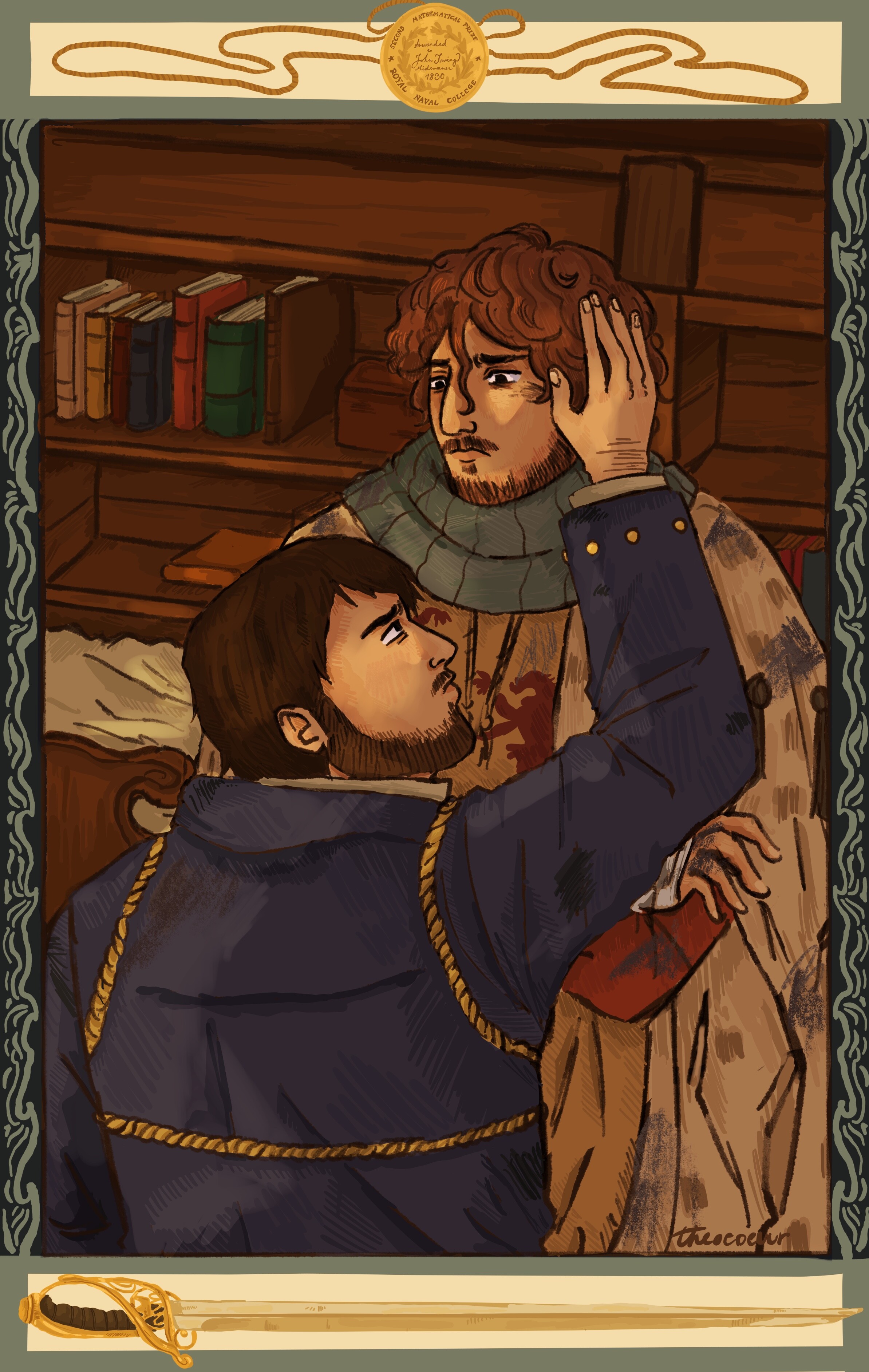
Tozer still looks like a shell of himself, John notices with despair, so different from the proud shining Marine he usually is. He is still in shock, John thinks; he is hunched over as though to be as small as possible, and his arms are wrapped around himself in a desperate attempt to soothe himself. It wrenches at John’s heart; he cannot stand it— no, he cannot even begin reconcile it, how this man who used to glow so golden and radiant, whose smile could never go unanswered, whose voice and bearing instilled such devotion and admiration in the men, whose mouth knows John’s own skin, now looks like this: beaten and broken. What has happened to him? What can John do?
John asks, taking care to keep his voice low and level, “Are you alright?”
Tozer just shakes his head, gripping at his arms with even more force.
“What’s wrong?”
Tozer fixes him with a vacant stare. Even in the darkness, John can see that his eyes are bright with tears.
“You can tell me,” John tries.
At last, Tozer lets go of his arms, but only so he can press the heels of his hands into his eyes, exhaling sharply as he does so.
“I’ve killed again,” Tozer says eventually, in a voice so low and empty that John is chilled by it. “Heather. He’s dead because of me. It were my idea to bring him. He’d still be tucked up all nice and safe on the ship if it weren’t for me.”
Tozer pauses to scrub painfully at his face as though he can remove the stain of his thoughts by doing so.
“I tried to save him, I tried. I tried. I carried him until I could carry him no more. I tried, but I couldn’t. I killed him, I—” he takes a big heaving sob, the force of it making him shudder. “Oh god. Perhaps it’s a kindness. He could not have made the walk—”
He exhales again, in a futile attempt to stop his shaking, and buries his face in his hands instead.
All the jealousy John had felt while watching Tozer tend to Heather in the Carnivale tent goes cold and heavy in the pit of his stomach. His heart aches. He understands now, in a great rush and with dreadful clarity, what he had been so foolishly blind to before, or perhaps simply unwilling to see. How much Tozer carried, yet had no person to share it with; had no place where he could be weak like this, no avenue to seek the comfort he could never admit he needed. But he did need it. And how selfish John has been, using Tozer for his explorations without ever once thinking that, despite his gleaming reputation and strength, Tozer was also merely a man— one with his own doubts and fears and need for support, which he has been forbidden by the virtue of his rank and station to ask for. So who did he have? Only John. John who has treated him so poorly. If that were true, then oh— oh, may god grant him the grace to make up for it. Let him be a comfort to Tozer now. What he should have been, long ago.
John does not know if it is too late, if Tozer will have him anymore after everything, but he tries anyway. He reaches for Tozer’s hands, bringing them away from his face, grasping deep for his own courage, and finally says, “No.”
He gives Tozer’s hand a desperate squeeze. “No,” he says again. “You’ve done nothing wrong. From the day we set sail, to this very instant, you have been exceptional—” He pauses. His throat has constricted with feeling.
Tozer does not move. There are tears now, running steadily down his face.
What can John do? His words are insufficient. His own emotions are thundering too strongly through him for anything he says to be of any use.
Without words, John rises up enough to take Tozer’s face between his hands, holding him like he’s the most precious sacred thing John has ever had the fortune to touch. Tozer lifts his downcast gaze at last, and the look on his face is so full of both despair and gratitude, such a devastating mix of emotions, that John feels near to tears himself.
Tozer’s eyes search his, desperate, and something quickens painfully in John’s chest. Still he holds on, unspeaking.
Tozer is shaking; shivering not with cold but in the grip of some emotion, and his breath comes unsteadily. John shushes Tozer, like he might a child, stroking his cheeks with the pads of his thumbs, trying to pat him into some kind of calmness. He feels the full weight of Tozer’s head come to rest against his palms, a heavy weight that John feels blessed to support. Not for the first time, he wonders at the miracle of human touch: at how the simple weight and pressure of another person’s skin against one’s own could make one’s fortitude crumble and strengthen at the same time. He’d been scrabbling for words before, but now he realises there is nothing to say. No— nothing that needs to be said.
John leans forward now, hands still cradling Tozer’s face, fingers cupping his jaw, and kisses him.
It is only the gentlest kiss; it should hardly be different from the kisses Tozer has pressed to other parts of his body, but it is their lips meeting that makes all the difference. The sensations overwhelm him: how Tozer’s lips are dry and rough yet soft against his own; the unfamiliar pressure of Tozer’s mouth on his; how Tozer smells like smoke and dried ale and sickroom ointment, but tastes sweeter than anything John has ever tasted before. When Tozer gasps in surprise, John feels that too, a light puff of air and then a sharp inhale that seems to draw John’s own breath with it. He thinks he feels Tozer’s mouth tremble beneath his, but John doesn’t move through it all, he cannot move, he cannot do anything besides remain there and hold Tozer in his kiss.
John has never kissed anyone before; he does not know if he is doing it right. But that he can do it at all with Tozer is a magnificent thing.
Just then, Tozer makes a sound, a small sob or a gasp. Whatever it is, it makes his lips part against John’s, and that slight movement feels like a lightning strike. John moves entirely by an instinct he did not know he possessed, chasing Tozer’s lips with his own so he can press them closer together. That seems to wake Tozer up, and he surges slightly towards John now to seal their mouths together with more force, some of his old strength and confidence restored to him as his hand comes to grip John’s shoulder hard.
John is so relieved to see the life returned to Tozer, so overcome with gladness and gratitude after all the fear, that a whimper escapes his throat.
Tozer breaks the kiss immediately.
“I’m sorry—” he starts. His forehead rests clumsily and heavily against John’s, his eyes still closed.
“No,” John interrupts. “It is I who owes you an apology, if you will let me give it.”
He senses Tozer wanting to protest, but John doesn’t let him.
“I— I’ve treated you poorly. I have been awful. I owe you an explanation at least, if not an apology. Would you let me, please?”
Finally, Tozer nods. John gives him a grateful smile and drops his hands from his face. He’ll speak his piece now, and pray that Tozer forgives him.
“I joined this expedition,” John begins at last. “Because I believed there to be a spiritual benefit in the journey. In coming here, I thought I would be separated at last from… temptation, and all the other ills of society, and I expected—I had hoped—to find purity. Sparseness. Perhaps even peace with what I was, if not transformation. Instead, I—” John pauses to take a breath, finding the memory hard. “Instead, I have been challenged at every turn by things that defy all sense and all the principles around which I have tried to build my life.”
He swallows. Is he going over long? Possibly, but he must. Tozer deserves the truth.
“It became apparent to me that you—what I was doing with you, I mean, my feelings for you—were becoming one of those things.”
He sees Tozer draw up, almost imperceptibly, in apprehension. “And I grew so afraid. Only now I realise that of everything that has happened, you were the only thing that truly mattered. The only one who made it all bearable. I was wrong to pull away, to be so cold to you. After everything you’ve done for me.” John has to pause for a moment, to force down the swell of emotion in his throat. “I’ve done you a terrible disservice, Tozer. I can’t tell you how sorry I am— you would be well within your rights to refuse me now, or report me.”
“Don’t say all that,” Tozer says miserably. “You know I’d never do a thing to hurt you.”
“Thank you,” John manages, blinking hard.
“I mean it." Tozer’s voice has thickened with emotion. He reaches between them to take John’s hand in his. “What you said, it’s true for me too. Only you make this bearable. You have kept all this from feeling like a curse.”
John stares at him, swallowing. His vision has misted over, but he can see Tozer’s sincerity clear on his face. “But I was terrible to you,” he says.
“No, love.” It sounds deliberate, the way he says it. It must mean something now. Tozer draws John to him then, into an embrace, his arms wrapping easily around John’s waist. “No, you weren’t.”
It is so dark—no man has wanted to light a lamp after tonight—that the arms holding him could be anyone at all. But it is Solomon Tozer who is holding him, and he is so glad; that precious pearl of knowledge is so wonderful that he feels like sobbing; he will never ask for anything more in the world.
How many moments pass like that? Long enough that John feels his pulse begin to calm, his breath start come easier, and Tozer relax beneath his touch.
They hold each other until the ringing of the bells reminds John of his duties. “I must go,” he says reluctantly. “The Captain has called for a meeting— but I will come back, I promise. Will you stay here? Rest, please, if you can.”
Tozer doesn’t say anything, but his fist curls tighter into John’s coat and he buries his face against John’s shoulder. Eventually, a few heartbeats later, John feels him nod.
He holds Tozer to his chest for a moment longer, and then releases him to kiss his forehead, cheek, lips. There is no lust or desire or even curiosity in this, only solace. Only solace, and understanding, and perhaps a kind of forgiveness.
There is much to do. Still, something drives John on through his long and tiring duties of the night— a flickering awareness having something to look forward to, a treasure so out of place here: Solomon Tozer waiting for him in his cabin. His very own… ! John quickly extinguishes the automatic guilt that snarls to life in his gut. There is no more need for that, not anymore. A new thing flutters to life in its place, a little curl of possession, of protectiveness over the man lying in his bed.
Some hours later, John slips back into his cabin to check on Tozer. Pleased to see that Tozer is asleep, he draws the old, rough washcloth away and replaces it instead with one of his own dampened handkerchiefs, placing it back on Tozer’s brow with gentle reverence, as though to anoint him. Almost absently, he pushes back the handsome waves of Tozer’s hair and presses a kiss to the crown of his head.
Nobody, in the chaos of this night, will notice that one of their own is in an officer’s berth. There is a relief in that, and John allows himself to sink to his knees on the floor next to the bed, leaning heavily against the bed frame, his forehead pressed to the edge of the thin mattress, letting his arms come to rest across Tozer’s sleeping form like a child saying his prayers.
He is exhausted, he feels it now. The men are settled for the night, Tozer is safe, and the officers have their orders. He is allowed to acknowledge how worn out he is now. Yet, in the depths of that weariness, he feels the small sparks of a fire start within him.
Something catches hold of his arm. It’s Tozer.
“You’re back,” comes his bleary sleep-roughened voice.
“Yes,” John says softly. “Don’t worry. Go back to sleep.”
“Come on up here, will you,” Tozer says, and shuffles the entire bulk of his body as close to the wall as he can, to make space for John in the bed. He beckons John up with gentle tugs at his arm, almost insisting, and John finds that he does want to join him, even if they will have to squeeze.
He clambers up.
There is not nearly enough space in that narrow bed even for John alone, much less for the both of them, but they press themselves together anyway until they’re lying chest to chest, so close there is no distance at all between them; so close it feels like there is no place of John’s body where Tozer does not touch, and it feels wonderful, even though the ornate curlicues of his bed frame press painfully into his back.
Tozer slips easily back into sleep like that, as though content now that John is with him. His arm settles around John’s waist, his hand curling very lightly into the fabric of John’s shirt just at the small of his back, a solid, welcome weight.
What a comfort this is, the mere act of lying next to another person; a comfort he’d never allowed himself to imagine. And such warmth! The heat that rises from between their bodies is like an embrace in itself. Emboldened, John dares to let his face rest closer to Tozer’s chest. There, he can feel the gentle rise of his breath; fancies he can even hear Tozer’s heart beat and feel its warmth, the one radiant spot of safety and comfort here at the end of the world.
“Solomon,” John whispers, as quietly as a prayer, and feels Tozer stir against him in his sleep. Saying his name is like swallowing a tonic— Solomon. He says it again, every syllable full and rich in his mouth.
After Tozer had kissed him earlier, he had rested his forehead on John’s, as if he could not bear to be apart. John understands that feeling now. He finds Tozer’s hand in the tangle of sheets and links his fingers with it. He feels his heart swell with tenderness, and then, suddenly and firmly, with resolution.
10.
The fire has changed things.
Or perhaps it is the dire absurdity of the entire expedition that has taken apart and put back together their customs and norms one last time before the ships are abandoned for good. John can’t help but imagine that this place has warped their usual sensibilities in the same way magnetic north here has set their compasses to spinning wildly, out of control and utterly useless.
For his part, John is not unsettled by any of it. He has grown accustomed to having Tozer with him, and Tozer, now recovered from the aftermath of the fire, continues to strides up to John’s cabin comfortably and confidently, his ease issuing an open challenge to anyone willing to call attention to it.
Nobody does.
With that, there is a resettling of the air around them, and they themselves are free of pretence. Tozer visits John because he wants to, although they never find the opportunity to spend the night together again. John touches him because he wants to. He is more open with Tozer, and when Tozer returns his affections with just as much sincerity and enthusiasm, John feels nothing but joy and gratitude.
They wait for the days to lengthen sufficiently, for the injured to recover, for the rest of the men to pack what supplies they can; all without knowing exactly how much time they have left before they are to leave the ships and begin the long walk. As the days grow brighter, John’s thoughts begin to wander. What has a life of purity and goodness got him? Fire and ice and a spirit bear haunting them, devouring them across a wasteland. Their own legs cut out from under them. Starvation. Death. But also Solomon Tozer.
Tozer is a solace in the cold; shield and sanctuary in kind. A life with him would be something wondrous. John lets himself think about it: Tozer’s solid, steadying presence by his side always; his self-assured love.
They are standing as they once did before, on a quiet part of the deck overlooking the frozen landscape, leaning ever so slightly on the gunwale before them. There is a weight that has settled uncomfortably in John’s stomach, a strange dark presence that seems to hover just behind his eyes. He has become so accustomed to this feeling that he barely notices it anymore— which is why he is slightly startled when Tozer does.
“Now what’s got you looking so glum over there?” Is what Tozer opens with, in a voice far more gentle than his words, the kindness and fondness simmering beneath his jocular tone. “You can tell me.”
John fixes his gaze on the unending expanse of ice before them, so bright it’s blinding, now that the sun is out. It hurts less than if he were to look at Tozer, with the way he knows Tozer must be looking at him.
And what can he say anyway? That the future is bleak, their chance of rescue close to zero, their likelihood of rescue nearly impossible; that this is all simply a matter of mathematics, not chance, or skill, or strategy? What can he offer that Tozer doesn’t already know, or hasn’t already felt?
“What do you think of raising sheep?” John says instead. It will never happen, and so he can speak of it. It is allowed.
“For you?” Tozer laughs, but it’s fond. “Odd, I’ll give you, but I can see it.”
“For you, too.”
He watches as the realisation dawns on Solomon’s face: bewildered first, and then soft, warm, as bright as the sun cresting the horizon.
“Always been one for cows myself,” he says. “Though I could do sheep, I reckon. With you.”
John swallows against the lump in his throat. Tozer is doing him an impossible kindness, indulging him like this. Giving shape to the future. He knows this, because even if the Arctic released them, the Royal Marines never would.
It occurs to John that Solomon Tozer is a man of greater faith than he is.
“Both then,” John says, decisively, but not without a pang of longing. This is the kind of talk that, in an ideal world, they might be having in bed, languid and lazy and warm with love. Instead, they are standing on the frigid deck of a ship half submerged within the ice. But John gives it no thought, because that ideal world was not one where he and Tozer could have ever met. “Sheep and cows.”
Tozer chuckles. “Sheep and cows. My word.”
“I’d like a dog too.”
“Well, we’d have to have one, wouldn’t we? For the sheep.”
Tozer’s easy use of the plural sends a thrill through him. We.
“We could go to Australia,” John continues, encouraged, knowing how foolish he sounds and not caring because Tozer is smiling at him now. The air is so cold and open, and the ice spreads out so endlessly in every direction, it seems hardly unreasonable to speak his most ridiculous desires out loud here into the vastness around them. “We could leave everything behind. Start afresh.”
Tozer hums, drawing closer to John almost absently. “Would be a lot warmer, for sure. And with your knack for numbers and my muscle? Yeah. I bet we could make a real go of it.”
John has no words for the feeling that rises, uncontrollable, in his chest. He pushes it down, along with the knowledge that barring some great mishap, there can be no life for Tozer outside of the Marines, not when he signed his life over to them more than a decade ago. It matters not. All that matters is that they are together now, and that their hands find each other on the frost-covered gunwale.
“The Captain will give the order any day now,” he tells Tozer. Nearly three months have passed, by his count, since that terrible night of the fire. “We’ll have a few days to prepare, of course, but it will be soon.”
Saying it out loud is to acknowledge the magnitude of what they are about to attempt, but he knows that he must.
Tozer takes it in, and then he says, quietly but firmly, “We’ll be ready.”
The ache settles very sweetly around John’s heart. “I know,” he agrees. “I just— it’s silly to think this now. Of all things. But once we leave, we won’t have any— any time to ourselves.”
For all he knows, this will be the very last time they will be together like this. Once they leave the ships, they’ll be out in the open, exposed, in canvas tents rather than wooden cabins. Their remaining days here are the last chance at any privacy they’re going to get for a while, or maybe ever. If so, then John wants to remember—
“Would you come to see me tonight?”
Tozer’s answer is almost immediate. “I’ll come as soon as I can.”
“And another thing— I hoped that you might call me John. After everything.”
“Of course I will,” Tozer replies, his voice thick with emotion. “John.”
At the sound of his name, John’s heart rises, with his spirits, into his throat. Here, separated from the rest of the world and stripped of everything, he is John after all. Not Lieutenant Irving, not even John Irving. He’s John. Just John. Solomon’s John.
“Solomon,” he whispers, wanting to give back even a little of the gift Solomon has given him.
John is lying in bed, sleepless. He’s on his side, turned to face the wall, his back to the door, because he can’t bear the thought of watching it all night only for Solomon not to come after all.
He catalogues every detail of his long wait as it unspools before him, knowing it may be the last time he ever gets to experience it, this moment of anticipation and everything it amplifies. The heavy tread of boots in the hallway beyond, the sound of his unlatched door sliding open. A blade of light flares against the wall, then is extinguished. The footsteps louder now, in the room with him. There is the muffled hush of gloves and a coat being removed and then placed very carefully on the desk, but still John does not dare to hope.
His breath catches only when he feels the mattress give under the weight of someone climbing carefully into the bed. He only lets himself believe it then. Solomon really has come. His body is chilled—John can feel it even through the covers, which Solomon has laid on top of so as to not disturb him—but he settles himself carefully behind John, curling his body neatly around John so they are lying perfectly slotted together, with his knees nestled in the crook of John’s own.
He feels the still cold tip of Solomon’s nose touch the skin behind his ear, and John smiles at the thought of his body warming Solomon’s. Then comes the softness of Tozer’s lips, just starting to skim the nape of his neck. Without intending to, John shivers.
“I’ve woken you,” Solomon says, sounding apologetic. His breath is heated; the contrast to his cold lips makes John stir, wanting to relieve the tension that has begun to build within him.
“I wasn’t asleep.”
Solomon’s arms tighten around him. He feels very warm now, and John is perfectly warm all along his back where Solomon is pressed against him. “Can’t you sleep?”
“I’m afraid,” John confesses. “I don’t know what will happen.”
Very softly, Solomon nudges at John’s shoulder, gently urging him to turn over onto his back so they can look at each other. John does, and sees that Solomon is bent over him, like a prince come to kiss a sleeping maiden— only his face is soft with worry; worry that John put there. John’s field of vision and the full range of his senses are filled with Tozer: his fine sandy hair, the concern in his dark eyes, the shadow cast by his large figure. His worries recede in the face of all that, everything making up the presence that has become his greatest treasure.
Solomon presses his lips to John’s cheek, finds them wet.
“John—”
But before Solomon can say anything more, John reaches up and kisses Solomon clumsily on the mouth.
It takes a beat for Solomon to get over his surprise, but when he does, Solomon deepens the kiss and slots their mouths together properly. John is so unprepared for it that he lets out a small gasp, but that only makes their lips move against each other even more— Solomon keeps kissing him anyway; he kisses him for a long while, deeply and full of feeling.
He feels stripped by it. Reduced to a solitary point of light building deep within his being— a truth, he thinks, that wants to soar forth. It is the only thing that can make any sense of why Solomon is here at all, holding him in this way, making him feel like this. What exactly it is, John cannot say. He has never felt anything like it before and so can draw no comparisons. He knows only that it is something pure, and that whatever it is, Solomon must feel it too. He must, or he would not be here.
“Shall I touch you, John?” Solomon’s voice is so low and comforting in the darkness. “May I?”
John can only nod minutely. In truth, he wants it more than anything.
Solomon repositions them so he is cradling John from the back again, his arms set fast around John’s waist to hold him close. Very carefully, one of his hands slips down John’s chest, abdomen, pelvis, to settle finally between John’s legs. John’s breath has caught in his throat, but he presses himself against Solomon’s touch, helping him push the sheets and his night clothes out of the way. John feels, against the back of his thigh, a hardness that reflects his own. And with it, a rush of relief and heat— that he is not the only one like this, that Solomon is just as affected by this as he is— And then—
And then comes the sudden sensation of Solomon’s hand—rough, big, warm, so gentle—around him; it is so wonderful that John feels he might cry from it. It should terrify him to be touched in such a way, but it does not. John is safe and warm here in Solomon’s embrace. There is nothing sordid about this; only a purity and a sudden swell of feeling that rises in him, in every part of him. His whole body is suffused with love— love for everything, for the cramped bed berth, even for the ice that howls outside, for everything that has led him here, to Solomon’s arms.
Solomon begins to caress him, slow and sweet, his other arm holding John firm across his chest. John barely manages to endure a full stroke before he is dangerously close to spilling; he tells Solomon so, and feels Solomon go rigid against him. His lips are pressed to John’s neck; the warmth of their touch radiates through John’s body, so close that John can feel them shape his name against his skin. And it’s that that undoes John, that more than anything else—more than Solomon between his legs, more even than the grip of his hand around him, the hot rough heat of Solomon’s other palm plastered against his mouth to quiet his cries—it’s Solomon whispering his Christian name in this moment like it’s something beloved, like a prayer, like a holy thing.
“There is so much I wish to give you,” John confesses later, in the gently fading darkness of the dawn before they both have to depart for their duties. It has become so easy to speak openly now that they have grown accustomed to having John’s cabin to themselves, and John dreads the looming loss of their privacy when they leave the ships behind. Which makes what he is about to do all the more important.
He continues. “And I will give you what you deserve, for everything you have done for me. I promise I will.” Without waiting for Solomon to respond, John takes the medal box from its place on the shelf and holds it out to Solomon. “But if we— if I don’t make it back, if something happens to me— well. Then I want you to have this first.”
Solomon just stares at him. His gaze flickers between John’s face and the box in his hands. John knows he knows what it is. What it means.
Quite without warning, Solomon steps forward, reaching not for the box but for John. Solomon kisses him for a long while, breaking it only to look John full in the face. “Nothing will happen to you,” he says, fiercely. “I won’t allow it.”
John leans into Solomon’s embrace for a few blissful moments. Softly, he breathes in the smell of him, the warmth and solid strength of his body. Every aspect of Solomon is John’s dearest treasure. The hardships and terror they have faced feel like nothing, hardly a price to pay for Solomon’s presence, and John says a quick prayer of gratitude that he has come to understand and possess this unspeakably precious thing. And then, strengthened, he looks up to meet Solomon’s gaze, seeing the fire in his eyes and the way his jaw works.
He will not fight Solomon on the statistical impossibility of his promise. It no longer distresses him, the prospect of his life cut short, now that he has been blessed enough to share a small part of it with Solomon.
“I know,” John says. “Still, I hope you will accept.”
Solomon, with shaking hands, reaches at last for the gift. He closes his fingers over it and John’s outstretched hand.
“I do,” he whispers.